Best Crash-Tested Dog Car Harnesses for the Baby Back Seat (2026)
Reader-supported — if you buy through our links we may earn a commission, at no extra cost to you. As an Amazon Associate I earn from qualifying purchases. Details
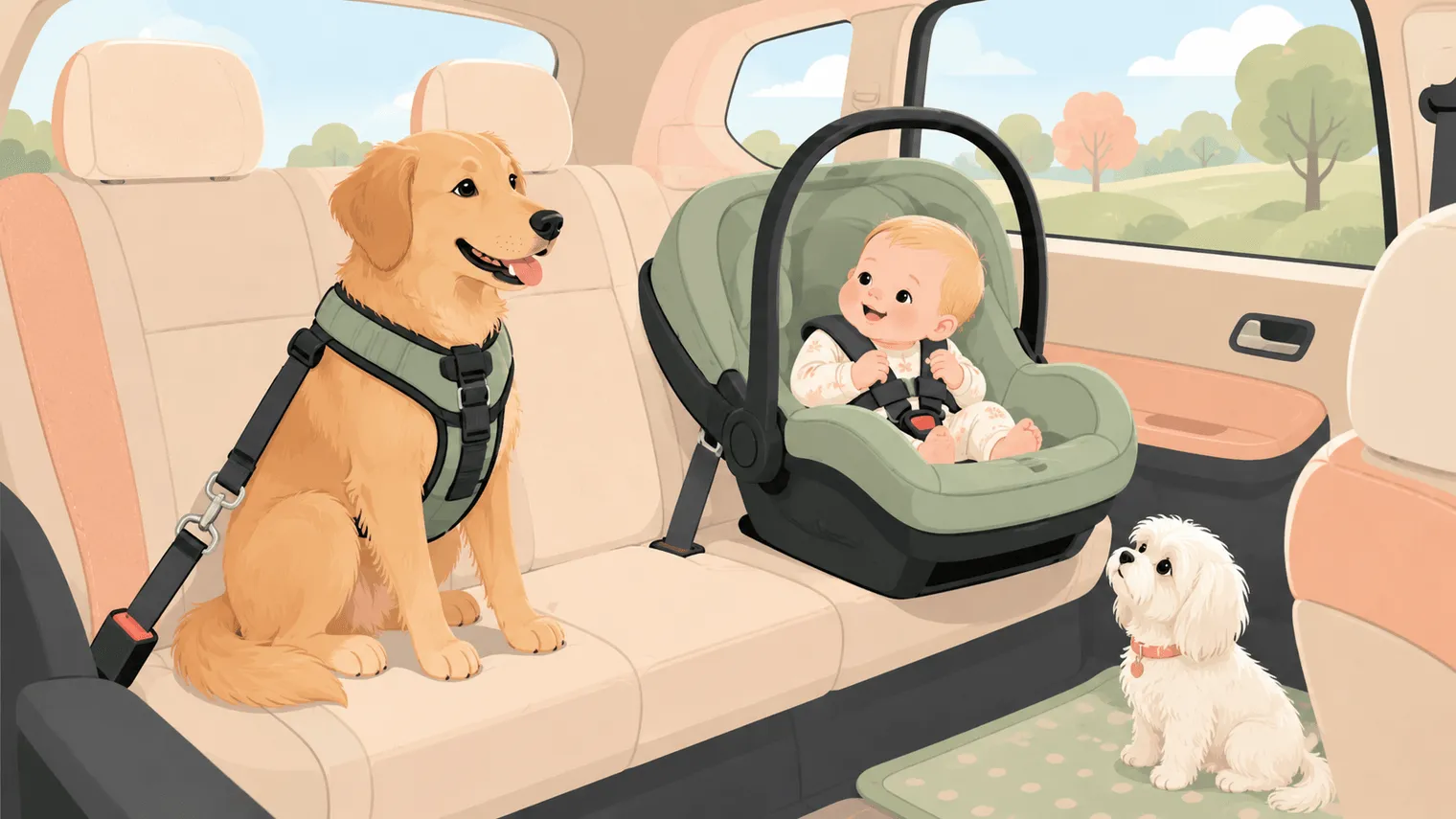
If you remember one thing from this guide, make it this: only a small handful of dog car harnesses have independent crash certification from the Center for Pet Safety, and for a household with both a dog and a baby riding in back, that independent proof — rather than a brand’s own marketing — is the whole ballgame. For most families that points to the Sleepypod Clickit Sport, because it earns that certification and clips to the regular seatbelt, leaving your baby’s anchor points untouched.
Quick honesty note: we haven’t strapped these into a sled or run any crash tests — nobody outside a certified lab should claim that. This guide is built from the published Center for Pet Safety results, the manufacturers’ spec sheets, and the consistent themes across several hundred owner reviews on Amazon, Chewy, and Reddit. Where independent data exists, we lean on it hard; where a brand only tests its own product, we say so plainly.
The physics that makes this a dog-and-baby problem
The back seat is shared real estate, and physics does not care which passenger you love more. An unrestrained dog becomes a projectile in a crash, and the force is enormous: commonly cited figures put a 60 lb dog at 35 mph at roughly a 2,700 lb projectile. If whatever sits in front of it is your rear-facing infant seat, your dog has just become a projectile aimed straight at the baby.
That single sentence reorganizes the whole shopping list. A loose dog isn’t only at risk himself — he’s a hazard to the smallest passenger in the car. So the bar isn’t “does the box say crash tested.” The bar is: is there independent proof this thing actually contains a dog in a collision, and does it do that without stealing the baby’s anchor points?
Only the Center for Pet Safety 5-star certified options clear the first half of that bar. Everything else — including some genuinely popular harnesses — is “crash tested” by its own maker, with no published third-party results.
How we chose
We compared the published certifications, the manufacturers’ spec sheets, and the owner-review patterns; we haven’t tested the field ourselves. Five things matter disproportionately when a restraint has to share a back seat with an infant, and they’re what we weighed for every harness here:
- Independent crash certification. Center for Pet Safety 5-star, tested to child-restraint sled standards. Manufacturer “crash tested” marketing with no published third-party results does not count.
- Back-seat fit beside an infant seat. A low, narrow profile that attaches to the vehicle seatbelt rather than competing for the baby seat’s LATCH/ISOFIX anchors.
- Anti-projectile containment. Three points of contact and load-spreading webbing that keep the dog from launching toward the baby in a frontal crash.
- Fit security across body types. No escape — because a dog that wriggles free ends up loose next to the infant, which is the exact scenario you’re trying to prevent.
- One-handed daily use. If it’s fiddly to buckle while you’re holding a baby, it gets skipped, and an unused restraint protects no one.
Sleepypod Clickit Sport: the one built for your actual back seat
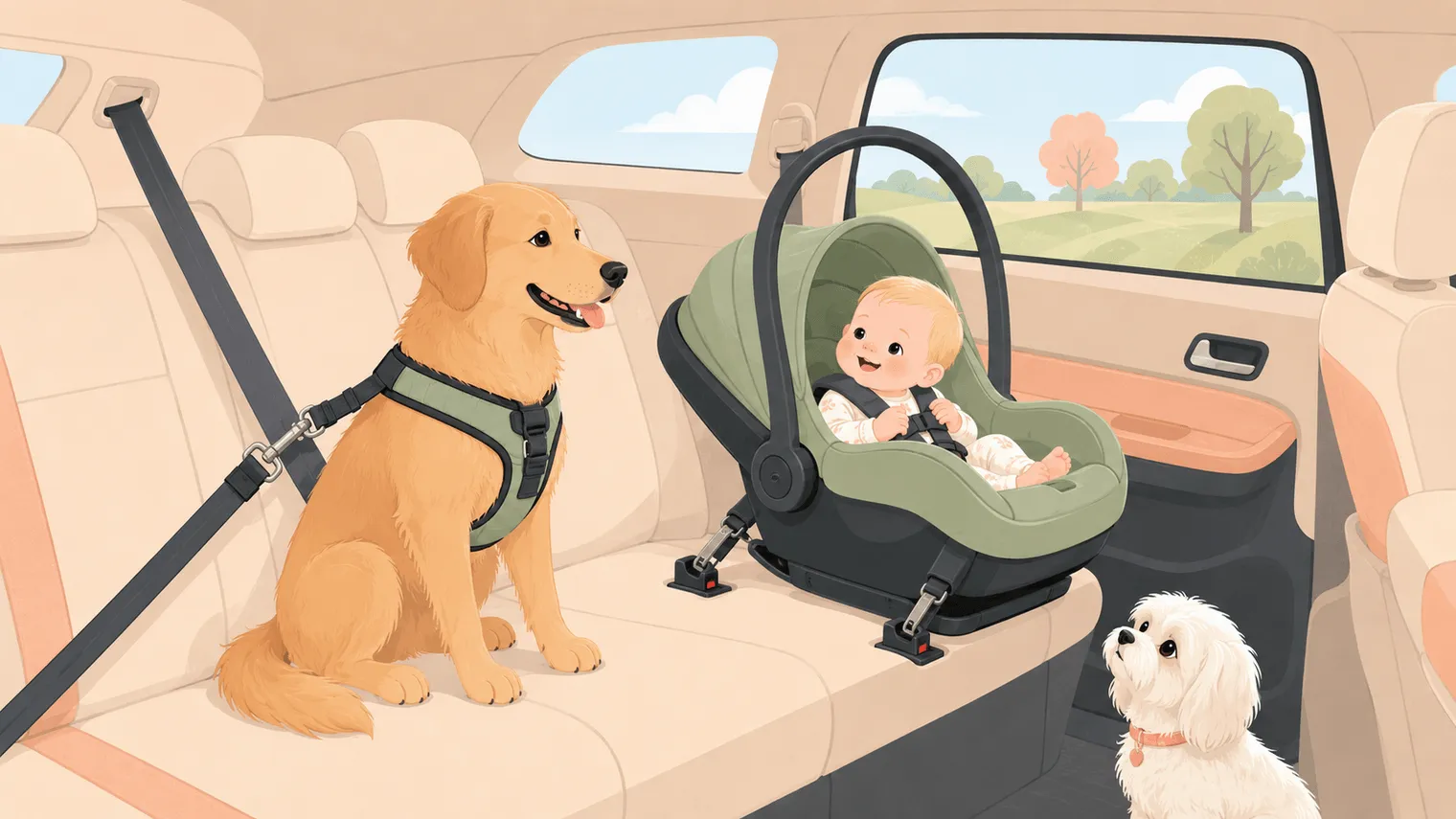
The Sleepypod Clickit Sport was the first dog harness ever to earn the Center for Pet Safety 5-star rating, and it remains the pick most owners land on for the typical dog + baby car. The reason is two-part. First, the certification is real and independent — Sleepypod published it, and CPS lists it. Second, and this is the part most reviews skip, the harness clips to the vehicle’s seatbelt via a short strap and S-clip. It never touches the LATCH bars.
That detail is everything in a two-passenger back seat. Your infant seat wants those anchors; the Sport politely declines them. Per the spec sheet its low, narrow padded vest also tucks beside a rear-facing infant seat without crowding it, so the dog can genuinely ride belted-in alongside the baby rather than across the car. The patented Infinity Loop webbing spreads crash load across the chest and shoulders, and three points of contact limit both forward launch and sideways slide.
The honest flaws, because there always are some. Owners are near-unanimous that the first fitting is fiddly — the multiple straps and the S-clip take a patient session to dial in, and a few report the seatbelt drawing extra slack or the retractor locking awkwardly until they get the geometry right. Owners also say sizing runs in-between for long-bodied or deep/narrow-chested dogs; several exchanged for the next size. And there are isolated owner quality reports — reflective trim peeling, one strap sewn reversed — so inspect yours while the return window is open. None of that dents the core fact: this is the certified, seatbelt-attached, baby-anchor-friendly harness, and that’s why owners keep recommending it.
EzyDog Drive: a credible backup, with one honest asterisk
The EzyDog Drive is a well-liked harness — many owners call it the best car harness they’ve owned, praising the memory-foam chest plate and the aluminum-alloy hardware, and one owner’s “rambunctious terrier” reportedly couldn’t escape it. It belts to the seatbelt, so it doesn’t compete with the baby’s anchors, and owners also use it as an everyday walking harness.
Here’s the asterisk we owe every parent: the EzyDog Drive is not CPS-certified. EzyDog says it was crash-tested to the US FMVSS-213 standard (with European and Australian standards also cited on its listings) — but those results are manufacturer-published, not independently verified the way the Sleepypod Clickit Sport’s certification is. That’s a meaningful step below the certified options, not a marketing footnote.
So it’s worth a look in one specific case: a dog that falls between Sleepypod sizes and genuinely doesn’t fit the certified picks. If that’s you, cinch it tight — the most common owner complaint is that loosely fitted dogs can slip out, and a dog that slips out in a sudden stop is exactly the loose-dog-next-to-the-baby outcome you bought a harness to avoid. Owners report sizing runs tricky and the neck cuff rides high on short-necked dogs, so fit is the whole game with this one.
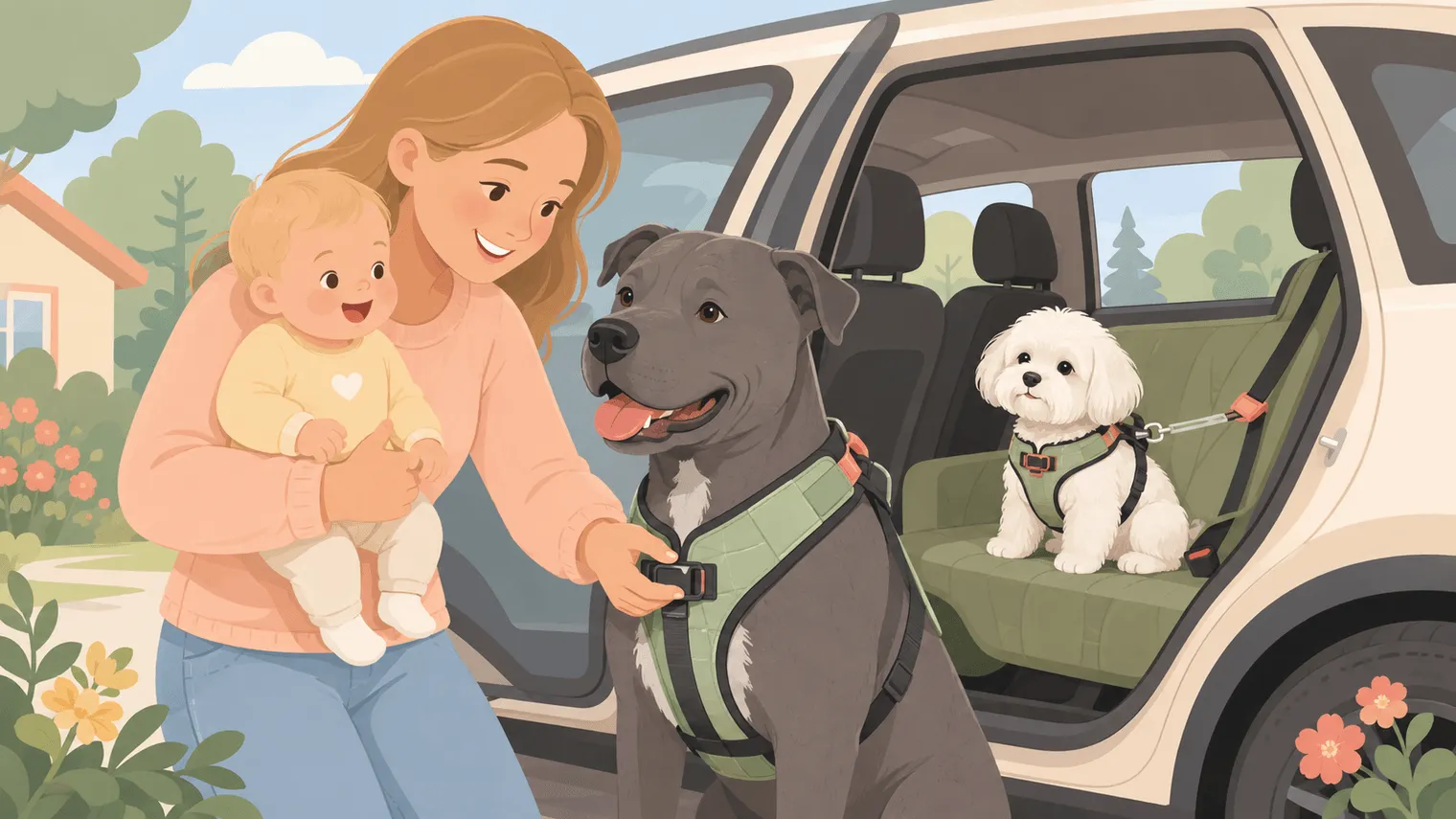
The cautionary pick: KONG Ultimate Safety Tether & Seat
We’re including the KONG Ultimate Safety Tether & Seat specifically so you don’t buy it for a dog + baby car. It’s a booster seat for dogs up to about 20 lb, owners like that it locks in firmly and keeps small dogs centered, and the booster height calms anxious travelers. So far so reasonable.
The problem is two strikes at once. First, it is not CPS-certified — there are no published independent crash results for it. Second, and worse for our use case, it anchors using the same 3-point LATCH/ISOFIX system your infant seat uses. In a two-passenger back seat you cannot give both the baby seat and the dog seat the same anchor bars, and you must never trade the baby’s certified anchor connection for the dog’s. If you already own one, the move is to switch the dog to a seatbelt-attached CPS-certified harness and let the baby keep the anchors.
The dog-and-baby rule, in one line
Pick a CPS-certified harness, attach it to the seatbelt — not the baby’s anchors — and seat the dog on the opposite side or behind the front passenger, never crowding the infant. If you’re still assembling the whole shared-household kit, our guides to introducing your dog to a newborn, baby gates for homes with dogs, and keeping the dog busy while you feed the baby cover the rest of the peace treaty. The car is just the part where physics writes the rules for you.
Our picks at a glance
Sleepypod Clickit Sport Plus (Crash-Tested Car Safety Dog Harness)
What stands out
- Center for Pet Safety 5-star certified — the first harness to earn it, tested to child-restraint sled standards
- Clips to the vehicle seatbelt, leaving the LATCH/ISOFIX anchors completely free for the baby seat
- Owners note the low, narrow padded vest tucks beside a rear-facing infant seat without crowding it
- Three points of contact limit both forward and sideways launch in a crash, per the spec sheet
Things to know
- Owners describe a steep first-time fitting curve — the multiple straps and S-clip take patience to dial in
- Sizing runs in-between for long-bodied or deep/narrow-chested dogs; some owners exchange sizes
- Isolated owner quality reports (reflective trim peeling, a reversed strap) — inspect yours on arrival
EzyDog Drive Dog Car Harness (FMVSS-213 manufacturer crash-tested)
What stands out
- Sturdy memory-foam chest plate that owners say inspires confidence
- Owners report it is escape-resistant on most dogs when fitted tightly
- Attaches to the seatbelt, so it does not compete with baby-seat anchors
- Owners also use it as a comfortable everyday walking harness
Things to know
- Not CPS-certified — crash testing is manufacturer-published only, not independently verified
- Owners widely report sizing is tricky; the neck cuff rides long on short-necked dogs
- Some owners say dogs slip out when the harness is not tightened correctly — fit-dependent
KONG Ultimate Safety Tether & Seat (booster seat with LATCH tether) — cautionary pick
What stands out
- Owners say it locks firmly into the child-seat LATCH points and feels anchored
- Keeps small dogs centered and reduces footwell launch under braking, per owners
- Booster height lets little dogs see out, which owners say calms anxious travelers
Things to know
- No independent crash certification and no published independent crash results
- Uses the SAME LATCH/ISOFIX anchors your infant seat needs — a direct conflict in the back seat
- Booster format only suits dogs up to ~20 lb and takes a full seat position
Questions families actually ask
What does "crash-tested" actually mean on a dog harness?
Usually nothing independently verified — most "crash tested" claims are the manufacturer testing its own product with no published third-party results. The only truly independent benchmark is the [Center for Pet Safety 5-star certification](https://www.centerforpetsafety.org/cps-certified/sleepypod-clickit-sport/), which puts harnesses through child-restraint sled standards and publishes the outcome. As of 2026 the Sleepypod Clickit Sport is the one widely reported as carrying it for the typical dog + baby back seat (Sleepypod also certifies its larger Clickit Terrain and Clickit Range variants).
Should the dog harness use the LATCH anchors or the seatbelt?
The seatbelt — leave the LATCH/ISOFIX anchors for the baby seat. Every CPS-certified harness here clips to the vehicle seatbelt by design, which is exactly why they coexist with an infant seat. A dog product that demands the LATCH bars, like the KONG booster, forces the two passengers to fight over the same hardware, and you should never trade the baby's certified anchor connection for the dog's.
Can the dog ride in the back seat right next to the baby?
Yes, if the dog is in a low-profile CPS-certified harness clipped to the seatbelt — but seat them on the opposite side or behind the front passenger, never crowding the infant seat. The Sleepypod Clickit Sport's narrow vest is built for exactly this; larger dogs still need their own clear seating position rather than sharing one spot with the baby.
What size dog do I buy for, and what if mine is between sizes?
Match the harness to the dog: the Sleepypod Clickit Sport covers roughly 18–90 lb, and for larger or barrel-chested dogs Sleepypod sizes up its certified Clickit Terrain and Clickit Range variants to around 110 lb. Deep, narrow-chested dogs like greyhounds are the classic between-sizes problem, and the EzyDog Drive is a reasonable non-certified fallback if nothing else fits, as long as you cinch it tight.
Why does an unrestrained dog matter so much with a baby in the car?
Because in a crash an unrestrained dog becomes a projectile aimed at whatever is in front of it. Commonly cited estimates put [a 60 lb dog at 35 mph at around a 2,700 lb projectile](https://www.avma.org/news/data-safety-regulations-lacking-when-it-comes-pets-and-vehicles), and if it strikes the seat that holds your infant, the dog lands on the baby. A CPS-certified three-point harness is the only restraint with independent proof it contains the dog in that exact scenario.