How to Keep Your Dog Busy While You Feed the Baby
Reader-supported — if you buy through our links we may earn a commission, at no extra cost to you. As an Amazon Associate I earn from qualifying purchases. Details
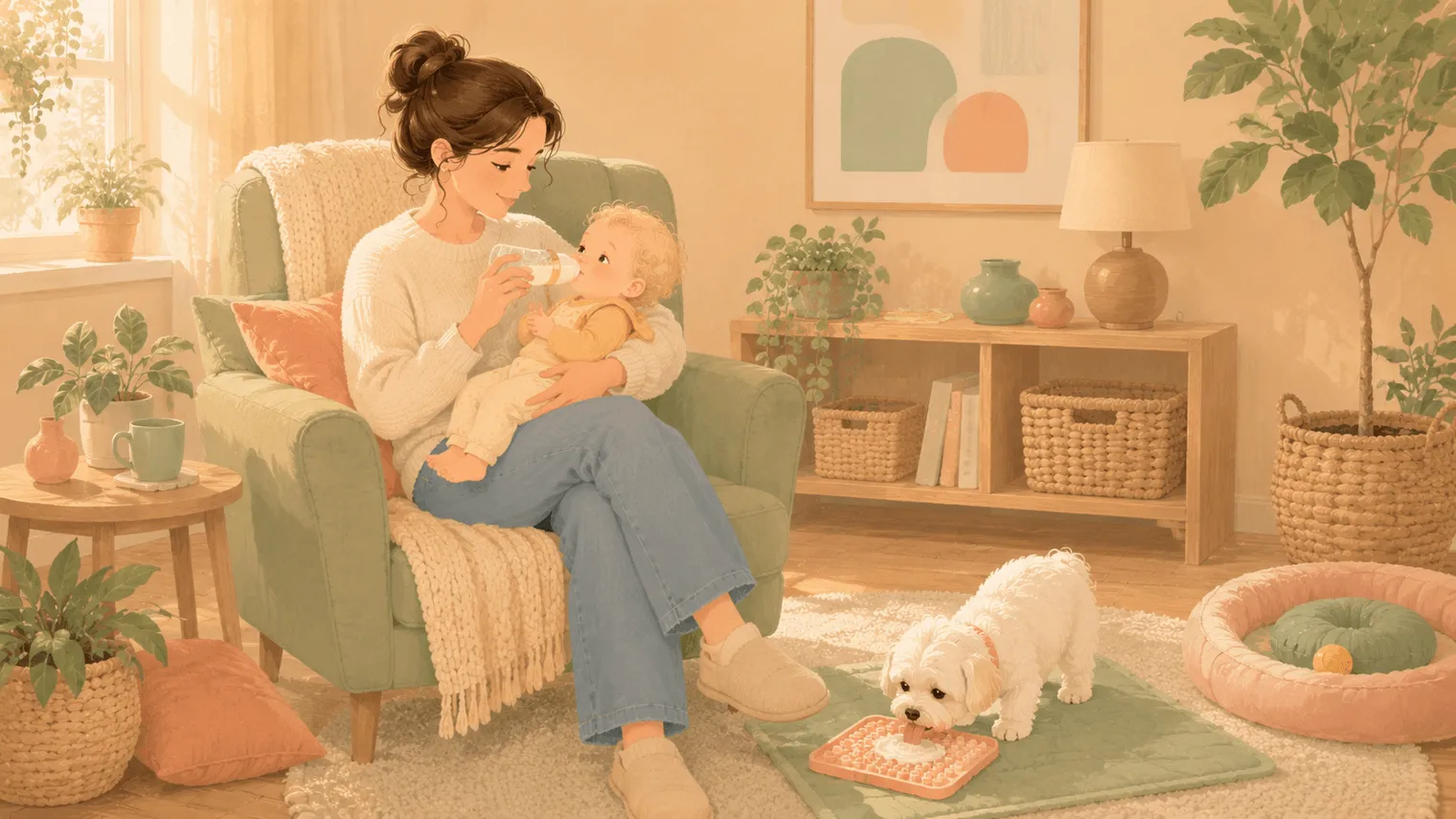
Here is a law of nature no parenting book mentions: the moment you sit down to feed the baby — hands full, posture committed, escape impossible — is the exact moment your dog remembers it has urgent business. A toy that must be presented. A bark that cannot wait. In the absence of a plan, feeding time becomes the dog’s open-mic night.
The plan, it turns out, is cheap and almost suspiciously simple: give the dog a better gig that starts at the same time, every time.
We haven’t tested these tools ourselves — this guide is built from the spec sheets, what vets and trainers say about licking, and the patterns across hundreds of owner reviews. Where owners and the spec sheet disagree, we say so.
The principle: parallel feeding
Trainers call the general idea management-plus-association; parents will recognize it as snacks for everyone. The dog gets its own absorbing, delicious project precisely when the baby gets fed. Run the pattern for a week or two and the baby’s feeding cues — the chair, the pillow, the bottle prep — start predicting the dog’s favorite part of the day. The species stop competing for the same moment.
What makes it work isn’t distraction; it’s that the right kind of project actually changes the dog’s state.
Why licking does the heavy lifting
Vets and trainers widely treat slow licking as a self-calming behavior for dogs — the canine equivalent, the thinking goes, of a stress ball that tastes like yogurt. That’s what makes a lick mat more clever than it looks: thirty seconds of spreading something dog-safe across textured rubber, ninety seconds in the freezer aisle of your prep routine, and many owners report buying twenty-plus minutes of a dog that is not only occupied but, by their accounts, actively winding itself down.
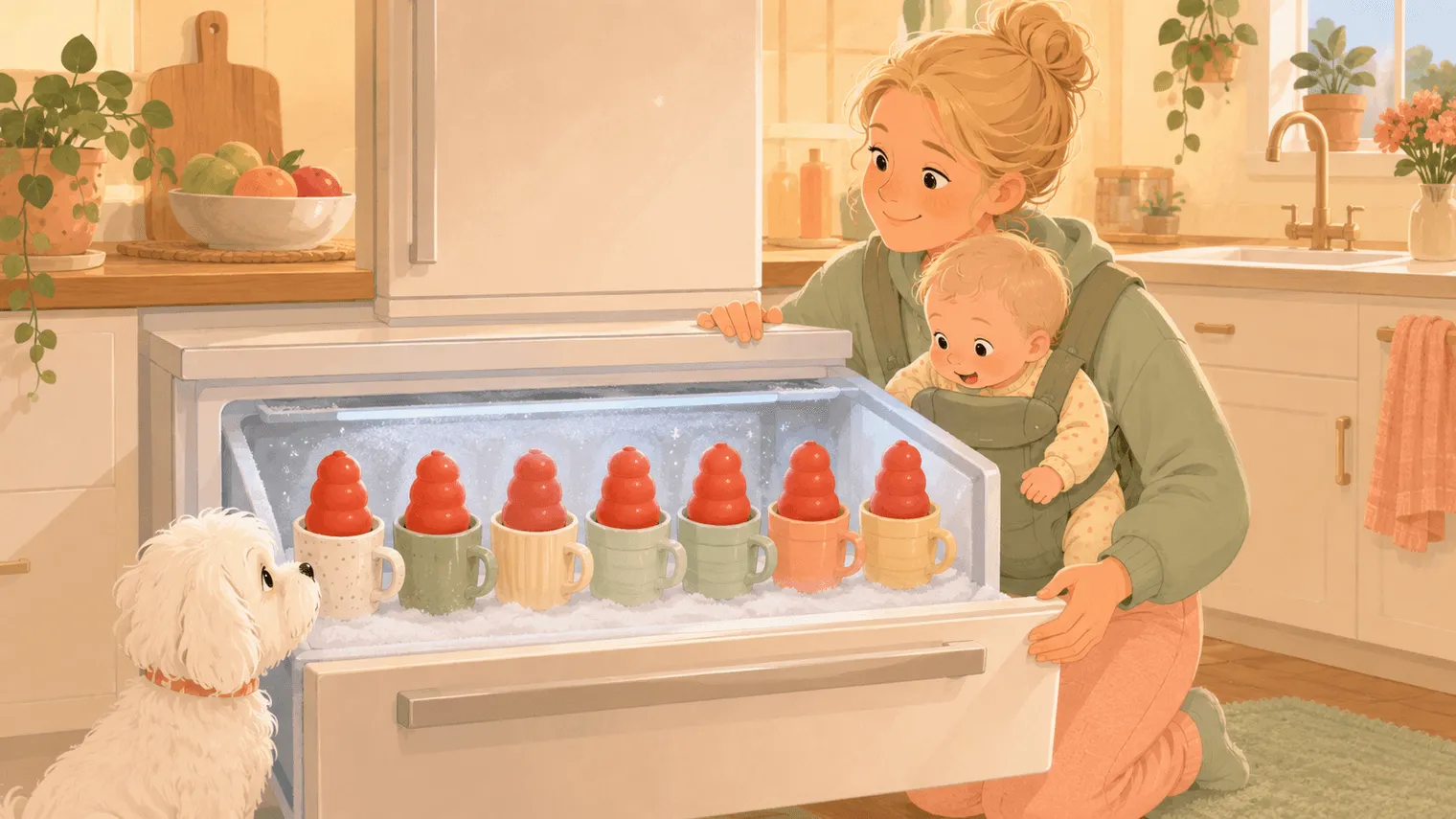
The frozen Kong is the longer-form version — stuffed, frozen, and excavated over the length of an entire cluster feed. The move owners keep recommending, straight from the parents-of-twins playbook: batch-prep five or six on Sunday and keep a dedicated freezer drawer. Future-you, pinned under a baby at 6 a.m., will high-five past-you.
Two practical notes, because honesty is the brand: stuffing is food, so subtract it from dinner — feeding-time enrichment that quietly doubles the dog’s calories solves one problem by creating a rounder one. And owners consistently advise supervising the first few sessions with any new item; a small minority of dogs decide the mat itself is the snack.
Building the routine
- Stage the gear. Lick mats and Kongs live in the freezer, prepped. The routine dies the day it requires preparation while a baby cries.
- Deploy on the cue, not the chaos. The mat comes out when you sit down to feed — before the whining starts, not as a reward for it.
- Same spot, every time. The dog’s station — a mat or bed with sightlines to you — makes the routine spatial. Dogs love a posting.
- Rotate the menu, not the ritual. Yogurt Monday, pumpkin Tuesday. The schedule stays identical; the flavor keeps it interesting.
- Phase it down later. In a few months the dog will mostly nap through feeds — the association did its job. Keep the occasional jackpot session so the magic spot stays magic.
When you do need distance
Some feeds — reflux babies, chaotic afternoons, a dog having A Day — genuinely go better with a barrier. That’s not failure, that’s management, and it’s why our gate guide exists. The aim across the whole first year is just to keep the ledger balanced: more feeding-times that mean good things for the dog than feeding-times that mean exile. Win that ratio and you’re raising the dog every toddler deserves: one who thinks the small human’s existence is excellent news.
Our picks at a glance
LickiMat Classic
What stands out
- Vets and trainers widely treat slow licking as self-soothing for dogs — owners use it as enrichment, not just distraction
- Costs less than two coffees, and owners report theirs last months
- Spread, freeze, deploy — per owner accounts, 20+ minutes of quiet from about 30 seconds of prep
Things to know
- The most common complaint: the soft rubber is no match for dogs who decide to chew the mat itself — owners suggest supervising the first sessions
- Owners note it goes in the dishwasher gross and comes out fine, but you do have to remember
KONG Classic
What stands out
- Frozen and stuffed, owners report it reliably buys the length of a full feeding session
- Tough rubber that owners say holds up well, with sizes from puppy to power-chewer per the spec sheet
- Owners batch-prep a freezer drawer on Sunday and coast all week
Things to know
- Calorie math counts — stuffing is food, so owners subtract it from dinner
- Owners say to size up if in doubt; an undersized Kong is a fetch toy, not a project
Questions families actually ask
Why does my dog act up exactly when I feed the baby?
Because feeding time is the most predictable attention-drought of the day, and dogs are pattern engines. You sit down, your hands are full, your eyes lock on the baby — from the dog's perspective, the resource just left the room. The fix isn't discipline; it's giving the dog its own predictable, excellent thing at the same moment.
When should I start this routine?
Before the baby arrives, ideally. Practice the sit-down-and-deploy ritual during pregnancy so the association is 'parent sits in that chair → my lick mat appears,' not 'baby appears → I get ignored.' Dogs handle change best when the new routine predates the disruption.
What do I put on a lick mat or in a Kong?
Anything dog-safe and spreadable: plain unsweetened yogurt, pureed pumpkin, mashed banana, the dog's own wet food, or peanut butter — checked to be xylitol-free, since [xylitol is toxic to dogs and turns up in some sugar-free peanut butters](https://www.aspca.org/news/updated-safety-warning-xylitol-how-protect-your-pets) (per the ASPCA). Freeze for longer sessions. Avoid anything sweetened or seasoned.
Is it okay to just gate the dog away during feeds?
Sometimes, sure — a gate with good visibility keeps the dog included while off your lap (we cover the best ones for exactly this). But making exile the only feeding-time policy teaches the dog that the baby predicts banishment. Enrichment in the same room, when it's workable, builds the better long-term association: baby time is good-things-happen time.