Dog Playpen vs. Baby Play Yard: Can One Pen Do Both Jobs?
Reader-supported — if you buy through our links we may earn a commission, at no extra cost to you. As an Amazon Associate I earn from qualifying purchases. Details
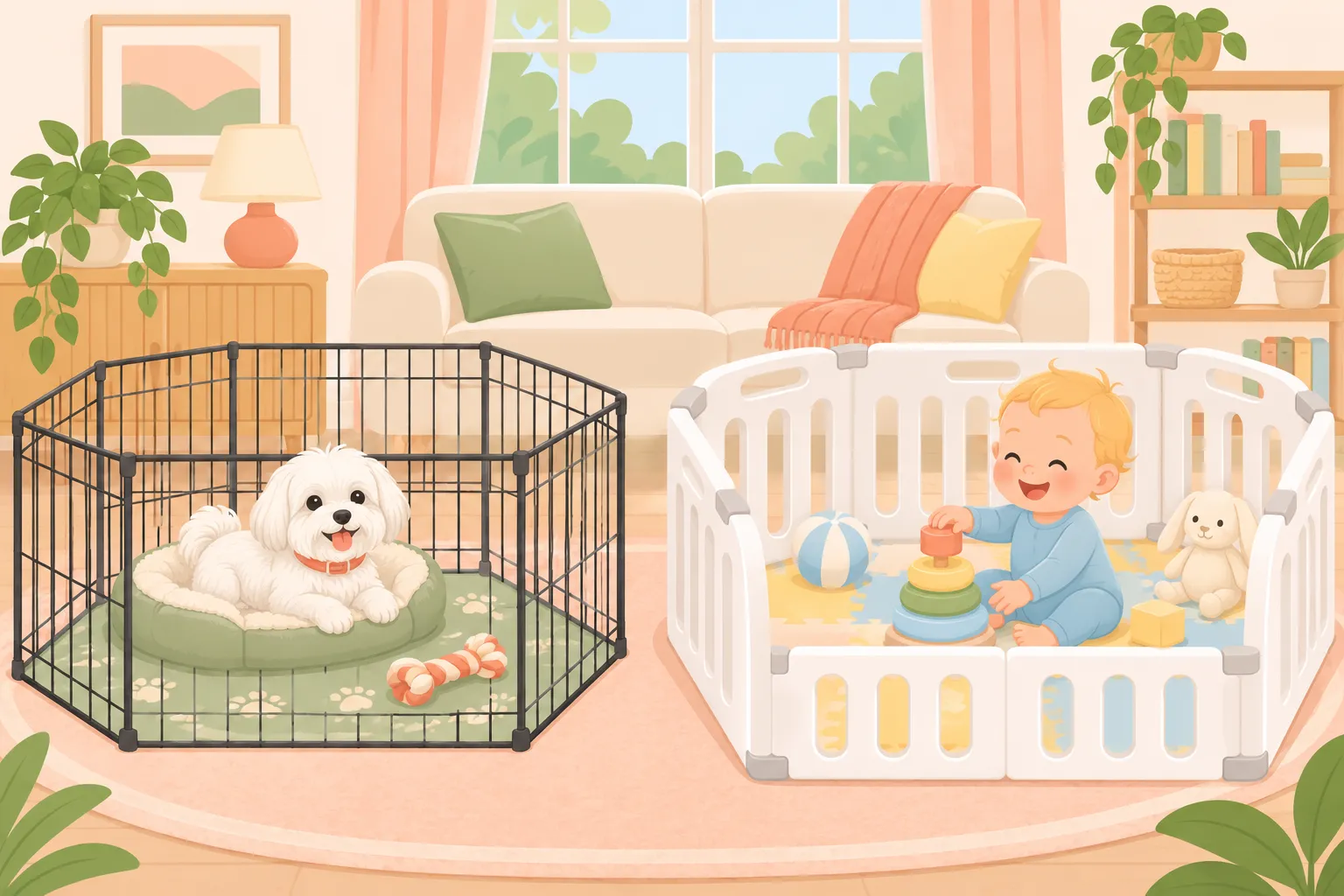
19-second summary
Can one pen do both jobs?
- For the baby Baby play yard — A children’s product covered by federal safety rules.
- For the dog Dog exercise pen — Gives the dog a calm zone of its own.
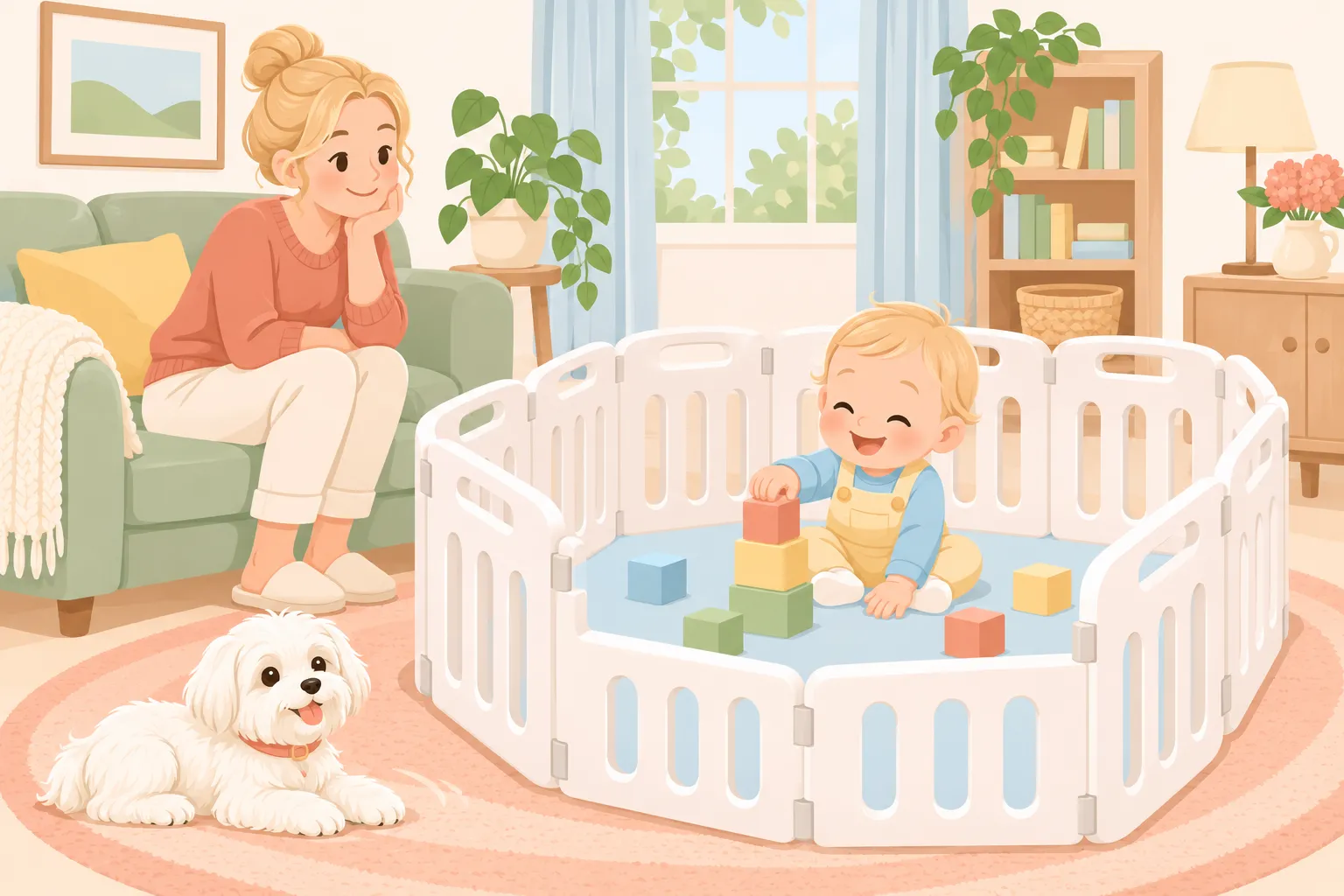
- The rule: Pen the dog or the baby → Never both in one pen → Supervise when they share a room.
Research-based summary — not hands-on testing.
The short answer: they look alike, but they aren’t interchangeable. A baby play yard is a children’s product covered by mandatory federal safety standards. A dog exercise pen is a pet product built for dogs. Buy each for its own job — and use them to give the dog and the baby separate safe zones, never one shared pen.
We haven’t tested these pens ourselves. This guide is built from the CPSC’s published rules for children’s play yards and enclosures, each product’s listing, and the recurring themes in owner reviews.
Every new parent with a dog eventually stands in the living room looking at a metal dog pen and thinking, “That’s basically a play yard.” It’s an understandable thought at 6 a.m. It’s also the one shortcut in this guide we’d skip.
Why they’re not the same product
In the US, children’s containment products are covered by mandatory CPSC safety standards, and which one applies depends on the design:
- Play yards with a floor — the portable, mesh-sided kind — fall under 16 CFR part 1221, which incorporates ASTM F406.
- Freestanding panel enclosures without a floor, which surround an area where a young child plays, fall under the gates and enclosures standard, 16 CFR part 1239, which incorporates ASTM F1004.
Under both, manufacturers must have products tested by a CPSC-accepted lab and issue a Children’s Product Certificate. Those rules exist because babies find hazards adults don’t — gaps, hinges, latches and edges at baby height. When you shop, check each product’s labeling and instructions for its intended use.
A dog exercise pen isn’t sold as a children’s product and isn’t built to that standard. That doesn’t make it a bad dog pen. It means its gaps, latches, stakes and edges were designed around dogs. The two products solve different problems, and the labels reflect that.
The real strategy: two zones, not one pen
The useful way to think about pens in a dog-and-baby home isn’t “which pen,” it’s who goes in the pen right now.
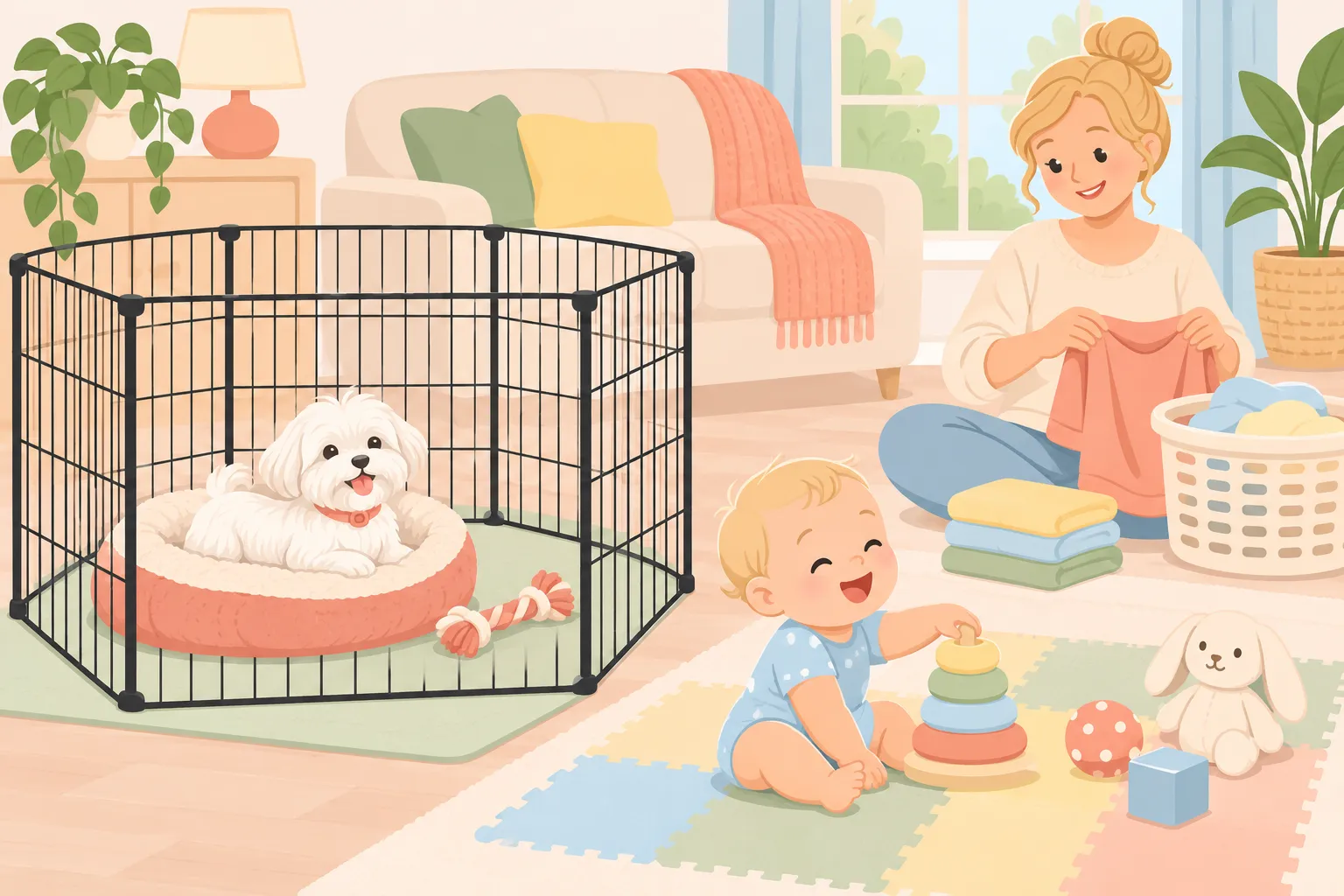
- Pen the dog during meals, when the baby is on the floor and you need two hands, during visits from excited relatives, or whenever the dog is overtired and grumbly.
- Pen the baby during floor time when the dog is loose, when you’re cooking, or when you need a minute.
- Never both together. A pen concentrates the dog and the baby in a small space with no exit — the opposite of what you want.
The dog pens: FXW Rollick and MidWest
FXW Rollick (24” H, 8 panels, around $70). Rod-connected panels that FXW says go together in under five minutes, a door, and ground stakes with rounded ball tops for outdoor use. Owners consistently describe it as sturdy for the price and well suited to puppies and small dogs; the most common nitpick is that the door latches take two hands — which, honestly, is a small price for a latch that’s harder for a dog to work open. FXW recommends a pad or carpet under it indoors. Leave the stakes out indoors; they’re for the yard.
MidWest 30” Exercise Pen (no door, around $45). Eight 24 x 30 inch panels make a 16 sq ft area that folds flat for storage. There’s no door, so you lift the dog in or step over — fine for a small dog, a nuisance for a big one. Owners praise its quality and easy setup.
Both are listed for smaller dogs. A jumper or a large dog needs taller panels or a gate-based setup — see our best baby gates for dogs guide.
The baby play yards: Superyard and My Play
Toddleroo Superyard (around $70–100). A heavy panel play yard sold for children, with extension panels that grow it into a room divider. Owners report the heavy panels stay put when a dog leans on the outside and a baby pulls to stand on the inside — exactly the stress test a dog home applies. On tile, owners say it needs the non-slip pads or a rug.
Regalo My Play (around $40–60). A lighter panel play yard that folds flat with a carry handle — owners describe it as handy for visits. The most common complaint is that lighter frame: owners with big dogs say a leaner can shift it, so it’s best with small-to-medium dogs.
Our best playpens for homes with dogs guide covers these two in more depth.
What to look for in a dog pen around a baby
- Height for your dog. Listings give a height and usually a dog size; a jumper needs more than the minimum.
- A latch you can work but the dog can’t. Two-handed latches are annoying and also exactly what keeps a clever dog in.
- Secure panel connections. Check them after setup and every so often after; a loose connector is where a panel comes free.
- Indoor footing. Leave ground stakes out indoors, and put the pen on a rug or pad so it doesn’t slide and scuff the floor.
- Placement. Away from the baby’s play area and the path to the door, but within sight of the family.
What to look for in a baby play yard
- It’s sold as a children’s product. Look for the manufacturer’s labeling and instructions for use with children; the maker can provide its Children’s Product Certificate.
- Follow the manual’s age, size and use limits — and stop using it for the baby when the manual says to.
- Check for recalls. The CPSC recalls database covers children’s products, including play yards.
- Inspect it regularly, especially in a dog home: chewed, bent or loose parts mean the yard is done for baby use.
- Stability against a dog. If your dog leans or jumps on things, a heavier panel yard (or a room the dog can’t reach) makes more sense than a light one.
Can a play yard double as a dog pen?
For a small, calm dog, for short periods — sometimes. But a play yard isn’t built for chewing, jumping or leaning, and a play yard that’s been chewed or bent shouldn’t go back into baby use. Given that a basic dog pen costs $45–70, buying each its own is the simpler answer.
Setup tips for a dog-and-baby room
- Place the dog pen where the dog can see the family — a pen in an empty room feels like punishment; a pen in the living room feels like a den.
- Give the dog something to do in it: a chew, a lick mat, a familiar bed. See keeping your dog busy while you feed the baby.
- Keep the baby’s yard away from the dog’s food and water bowls, and out of the dog’s usual path to the door.
- Check latches and connections on both pens regularly; a loose panel is how escapes happen.
- Supervise whenever the dog and the baby are in the same room, pens or not.
Which should you buy?
- For the dog: the FXW Rollick if you want a door; the MidWest 30” if you want the simplest, cheapest foldable option with slightly taller panels.
- For the baby: the Toddleroo Superyard for a large, heavy play area, or the Regalo My Play for a lighter yard that folds flat for visits.
- For both: one of each. It’s not overspending — it’s two different products for two different jobs.
Put plainly
A dog pen and a baby play yard are cousins, not twins. Use the dog pen to give the dog a calm spot, the play yard to give the baby a safe one, and never put them in together. That’s the whole system, and it’s a lot cheaper than learning the hard way that each product has its own job.
Sources
- U.S. CPSC: Play Yards business guidance (16 CFR part 1221)
- U.S. CPSC: Gates and Enclosures (16 CFR part 1239)
- FXW Rollick and MidWest exercise pen product listings.
- Toddleroo Superyard and Regalo My Play details as covered in our best playpens for homes with dogs guide.
Our picks at a glance
FXW Rollick Dog Playpen, 24" H, 8 Panels
What stands out
- Rod-connected panels that assemble in under 5 minutes and can be added or removed, per the listing
- Has a door; ground stakes with rounded tops for outdoor use, per the listing
- Owners frequently mention it as sturdy for its price
Things to know
- Owners note the door latches take two hands
- 24" height is meant for small dogs; owners disagree on long-term durability
MidWest 30" Exercise Pen (No Door)
What stands out
- Eight 24 x 30 inch panels make a 16 sq ft area, per the listing
- Folds flat; tool-free setup with thumb-snaps and ground anchors
- Owners consistently praise its quality and easy setup
Things to know
- No door — you lift the dog in and out, or step over
- Suited to small and medium dogs, per the listing
Toddleroo by North States Superyard
What stands out
- Owners report the heavy panels stay put when a dog leans on the outside and a baby pulls to stand on the inside
- Reconfigures from hexagon to wall-anchored barrier to fireplace fence, per the spec sheet
- Extension panels grow it from playpen to room divider over time
Things to know
- Owners note it’s heavy enough that "portable" means between rooms, not on vacations
- On hard floors, owners say it needs the non-slip pads or a rug — it can scoot on tile
Regalo My Play Portable Play Yard
What stands out
- Folds flat with a carry handle — owners describe it as handy for visits
- Owners report setup in under a minute, no tools
Things to know
- The most common complaint is the lighter frame: owners with big dogs say a leaner can shift it — best for small-to-medium dogs
Questions families actually ask
Can I use a dog playpen for my baby?
We wouldn’t. Children’s play yards and enclosures sold in the US fall under mandatory CPSC safety standards — 16 CFR part 1221 for play yards with a floor, and 16 CFR part 1239 for gates and freestanding enclosures — with third-party testing and a Children’s Product Certificate. A dog exercise pen is a pet product that isn’t sold as a children’s product or tested to those standards; its gaps, latches, stakes and edges are designed with dogs in mind, not babies.
Can I use a baby play yard for my dog?
For a small, calm dog for short periods it can work, but it isn’t designed for it. A dog that jumps, chews or leans can shift or damage a play yard — and a damaged play yard shouldn’t go back into baby use. It’s simpler to buy each its own.
Should I pen the dog or the baby?
Whichever gives you the most calm with the least fuss — often the dog during meals and busy moments, the baby during floor time when you need two hands. The rule that matters is never putting the dog and the baby in the same pen, and always supervising when they share a room.
How tall should a dog pen be around a baby?
Tall enough that your dog can’t jump or climb out. The 24" FXW and 30" MidWest pens are listed for small and small-to-medium dogs; jumpers and larger dogs need taller panels or a gate setup instead.