How to Walk Your Dog With a Stroller (Without Losing Either)
Reader-supported — if you buy through our links we may earn a commission, at no extra cost to you. As an Amazon Associate I earn from qualifying purchases. Details
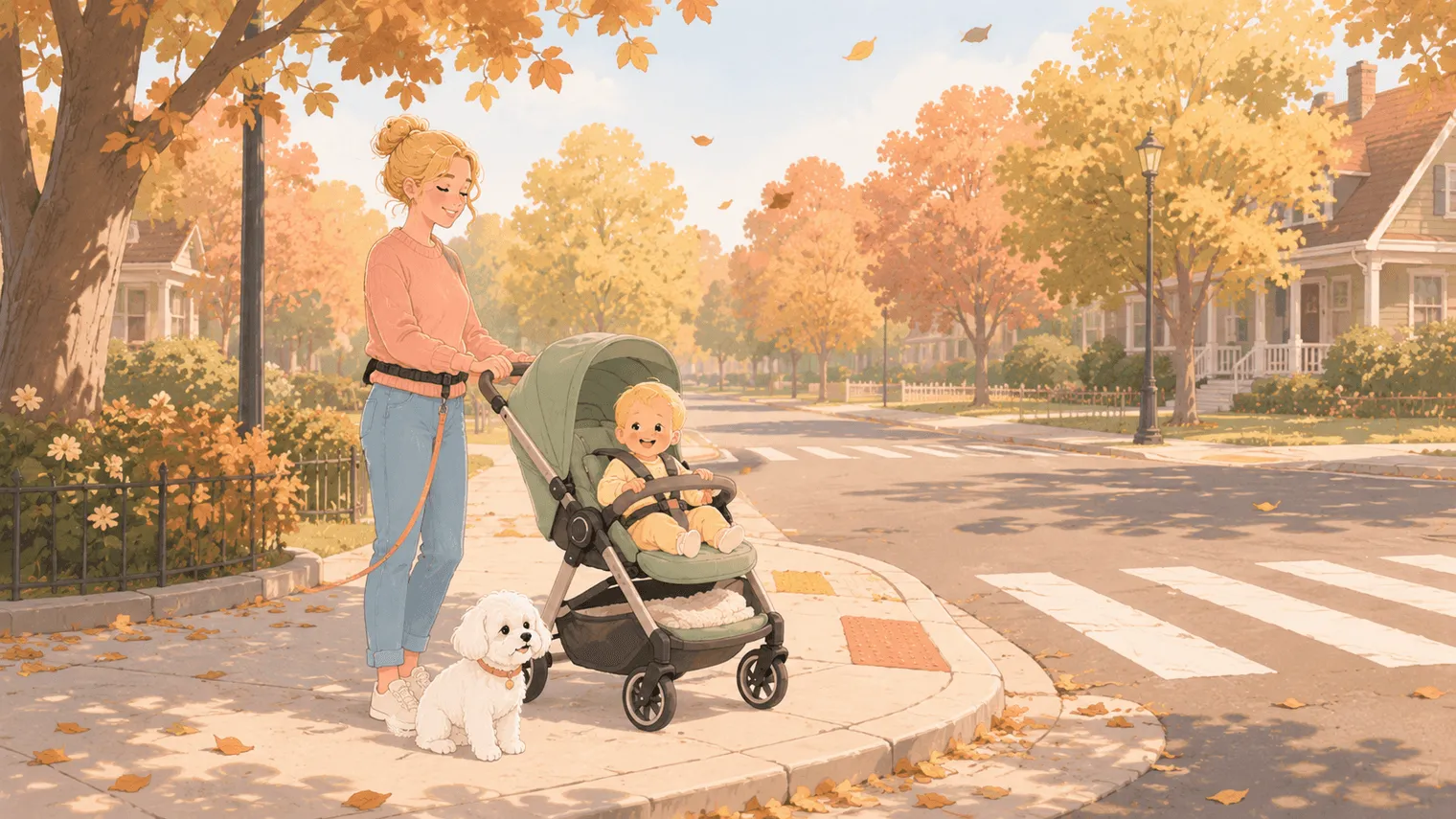
The two-species walk is one of the great quality-of-life upgrades of new parenthood: dog exercised, baby aired, parent moving, everyone home tired. It’s also a skill — a small piece of choreography that goes beautifully once you’ve built it and chaotically if you improvise it. This is the complete build, from gear to graduation.
Rule zero, before anything else
The leash never attaches to the stroller. Not looped on the handlebar, not carabinered to the frame, not “just while I fix the blanket.” A stroller is a tall, light lever; a dog is a force generator at the end of a line; a squirrel is an ignition switch. The lunge that would merely yank your arm can tip the lever, and dog-and-baby safety educators are blunt about it: Family Paws Parent Education says plainly, “Never tie a dog leash to your stroller.” The leash attaches to a human — hand, or better, waist.
Everything else in this guide is technique. That one is law.
The gear stack
Short list, mostly cheap: a waist leash with a bungee section (force absorption plus two free hands — our picks), a front-clip harness if your dog pulls (steering geometry beats strength), poop bags clipped to the stroller (the one thing that may hang on the handlebar), and water for the dog on warm days. Skip retractable leashes entirely for this job — variable-length cord plus wheels plus pedestrians is a geometry problem with no good solutions.
The training progression
The mistake is debuting everything at once: new gear, new vehicle, new baby, day one. Stack the pieces instead, each for a few days:
- Empty stroller, no dog. You, learning the vehicle — curbs, corners, one-handed pushing. (Do this during pregnancy if you can.)
- Empty stroller, plus dog. The dog meets the rolling thing in the driveway: sniff it parked, walk beside it moving, treats flowing. The stroller becomes furniture that moves.
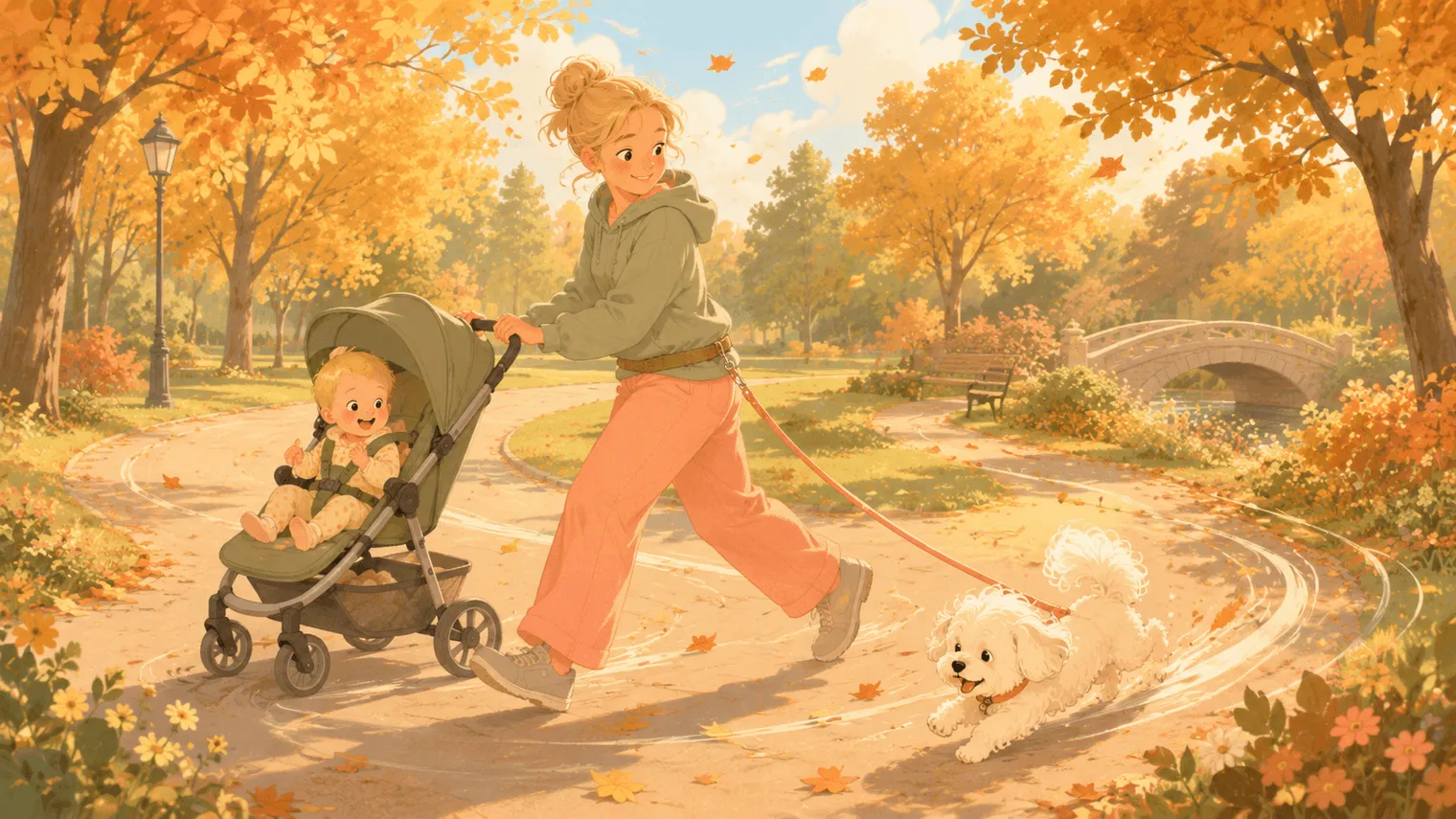
- Assign the lane. Dog on one side — same side forever — at the rear axle, on the waist leash. Short loops, heavy reinforcement for holding position. The dog is learning a new heel: beside the wheel is the paycheck zone.
- Add the baby. By now it’s a boring walk with a slightly heavier stroller, which is exactly the energy you want. Keep the first real walks short and victory-lap easy.
The choreography details
Corners: dog on the inside of a turn gets squeezed; on the outside, swung wide. Slow down, say your turn cue (“with me” works), and reward through the arc — within a week the dog reads your shoulders.
 Curbs and crossings: build an automatic sit at every
curb; it converts the most dangerous moments into the most rehearsed.
Greetings: other dogs and admiring strangers get managed one at
a time — park the stroller, brake on, body between, before any
meet-and-greet. And reading your dog: a stressed dog
whispers before it shouts
— lip licks
(the ASPCA lists lip licking and yawning among the displacement signals of a
stressed or conflicted dog) and lagging on stroller walks mean shorten the
route, not push through.
Curbs and crossings: build an automatic sit at every
curb; it converts the most dangerous moments into the most rehearsed.
Greetings: other dogs and admiring strangers get managed one at
a time — park the stroller, brake on, body between, before any
meet-and-greet. And reading your dog: a stressed dog
whispers before it shouts
— lip licks
(the ASPCA lists lip licking and yawning among the displacement signals of a
stressed or conflicted dog) and lagging on stroller walks mean shorten the
route, not push through.
When it clicks
Give it two or three weeks of consistency and the whole production compresses into a single fluid departure: harness, belt, brake, go. The dog assigns itself to the wheel, the baby develops strong opinions about leaf shadows, and you get the version of new parenthood the brochure promised — everyone outside, everyone moving, nobody dragging anybody. It’s the best daily habit a dog-and-baby household can build, and it’s built, not bought.
Questions families actually ask
Can I attach the leash to the stroller "just for a second"?
No — this is the one absolute in the whole guide. A leash on the stroller turns any lunge into stroller physics: tipping force applied above the wheels, with your baby inside. Dog-and-baby safety educators are emphatic about it — [Family Paws Parent Education](https://www.familypaws.com/babywearing-vs-strollering/) puts it as plainly as it gets: never tie a dog leash to your stroller. Hands or waist, never the handlebar, not even for a second — seconds are when squirrels happen.
Which side should the dog walk on?
Pick one and never renegotiate. Most people put the dog on the side away from traffic, on a short-ish lead at the stroller's rear axle — beside you, not scouting ahead where the front wheel meets dog toes. The consistency matters more than the side: a dog with one assigned lane stops weaving within a couple of weeks.
My dog pulls. Stroller walks feel impossible — what first?
Fix pulling before combining it with the stroller, not during. Two weeks of front-clip harness work on solo walks pays off faster than any gear. The stroller walk is a graduation exercise, and a front-clip harness plus a waist leash is the standard diploma kit.
What about a reactive dog?
Be honest about the stakes: a dog that lunges at dogs, bikes, or skateboards is carrying a problem that a stroller multiplies. Split the walks (one adult, one dog; one adult, one stroller) while you work with a trainer on the reactivity — that's not defeat, that's sequencing. The combined walk is a privilege the training unlocks.