Shark AV2501AE vs. Roborock Q7 M5+: Which Budget Self-Emptying Robot Fits a Dog Home?
Reader-supported — if you buy through our links we may earn a commission, at no extra cost to you. As an Amazon Associate I earn from qualifying purchases. Details
19-second summary
Two budget self-emptying robots for a dog home
- No bags, vacuum only? Shark AV2501AE — Bagless base with HEPA filtration, per Shark.
- Want mopping too? Roborock Q7 M5+ — Vacuums and mops at the lower price.
- Heads up: Pet hair is a weak spot in testing — keep the brush clear → Best with light shedders → Run after the dog’s walk.
Research-based summary — not hands-on testing.
The short answer: both are popular budget robots with self-emptying docks, and both have the same honest catch in a dog home — independent testing found pet hair a weak spot for both (for the Shark, on a closely related model). Choose the Shark AV2501AE if you want a bagless, HEPA-filtered base and only need vacuuming. Choose the Roborock Q7 M5+ if you want mopping too, at the lower price. If you have a heavy shedder, look at a robot built for hair instead.
We haven’t tested these robots ourselves. This comparison is built from each maker’s listing, independent testing from RTINGS, Vacuum Wars and TechGearLab, and the recurring themes in owner reviews.
A self-emptying robot is the parent-friendly version of a robot vacuum: it dumps its own bin into a dock, so the daily chore becomes a monthly one. At around $200–290, these two are the most common entry points. The differences are in the dock, the mop, and how honest you want to be about your dog’s coat.
Where they’re the same
- Self-emptying docks that take over the bin-emptying chore.
- LiDAR mapping, so you can schedule cleans and set no-go zones around the water bowl and the play mat.
- App and voice control.
- No camera mentioned on either listing. Shark’s listing says its LiDAR detects and avoids objects in its path, but neither listing claims to recognize pet waste — so don’t count on either to steer around a dog accident.
- Pet hair is a weak spot for both in independent testing — for the Shark, on a closely related model (more below).
Difference #1: the dock — bagless vs. bags
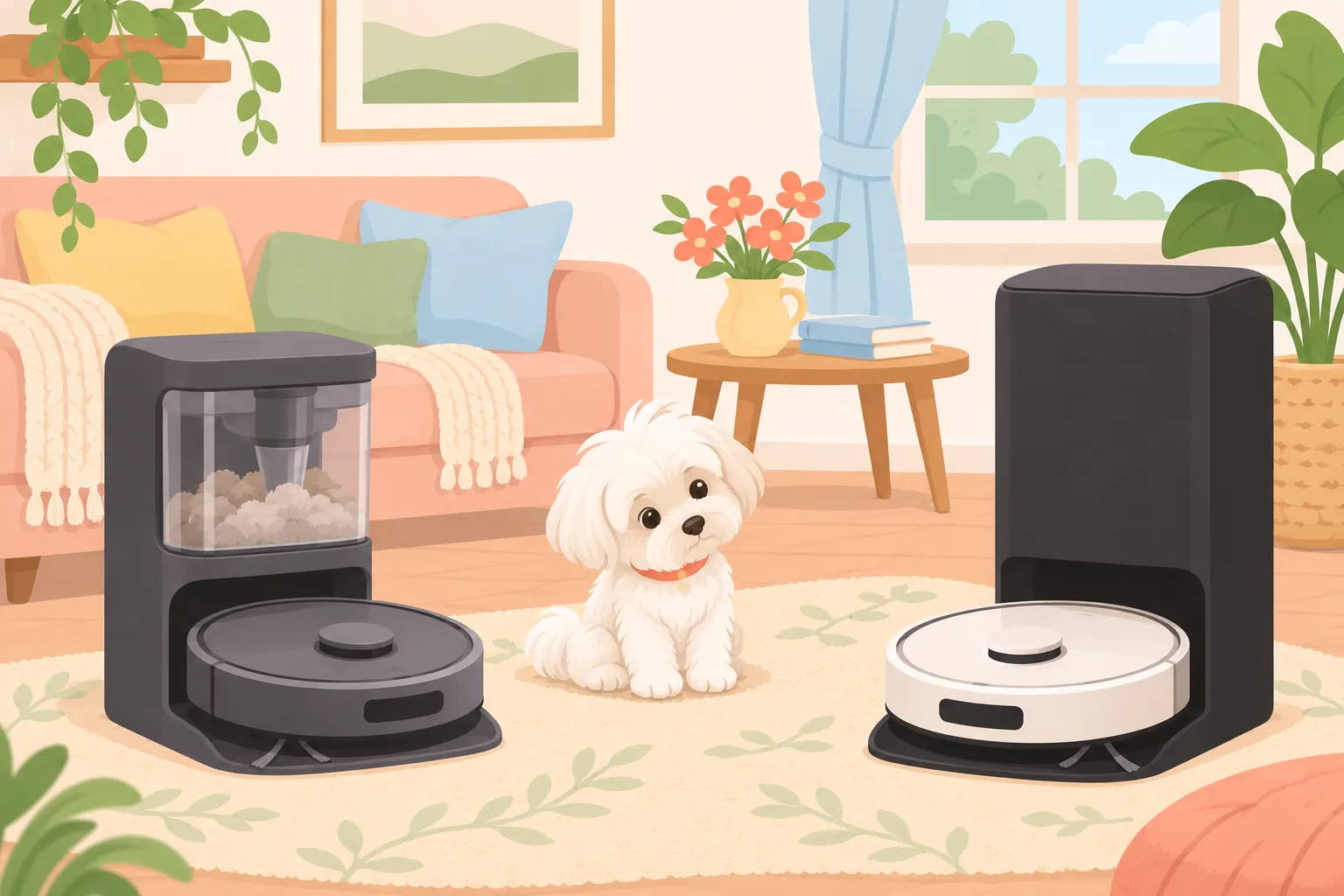
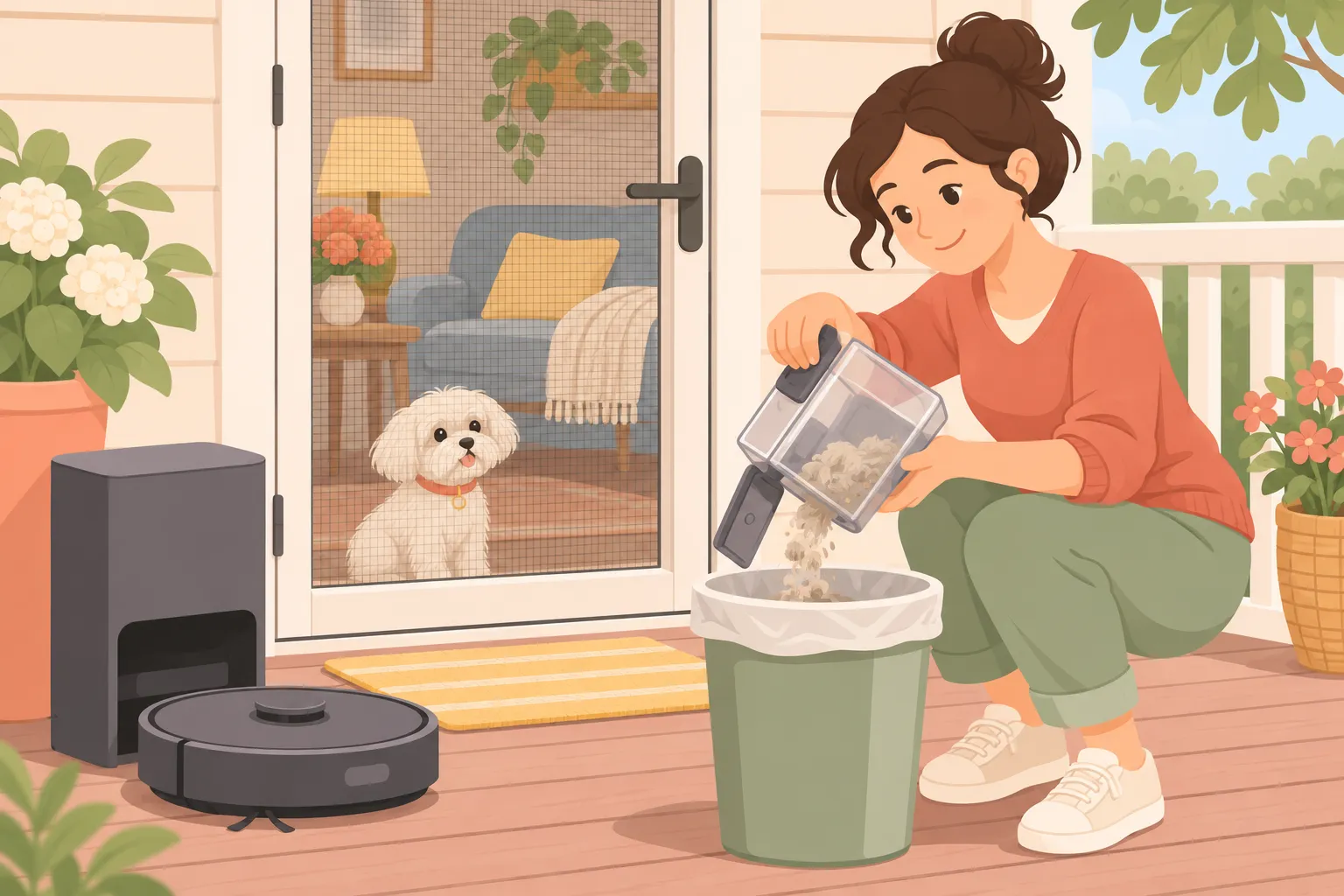
- Shark AV2501AE: a bagless self-empty base that Shark says holds up to 60 days of debris, with true HEPA filtration that captures 99.97% of particles down to 0.3 microns, per Shark. In Vacuum Wars’ testing with cat hair, the base emptied the robot’s bin in almost every case.
- Roborock Q7 M5+: a dock with a sealed 2.7 L dust bag that Roborock rates for up to 7–9 weeks.
Bagless means no bags to buy, but you’ll empty the base bin yourself — a dusty job in a dander-heavy house. Bags cost money but seal the mess in. Neither is wrong; it depends on whether you’d rather spend money or time.
Difference #2: mopping
- Shark AV2501AE: vacuum only.
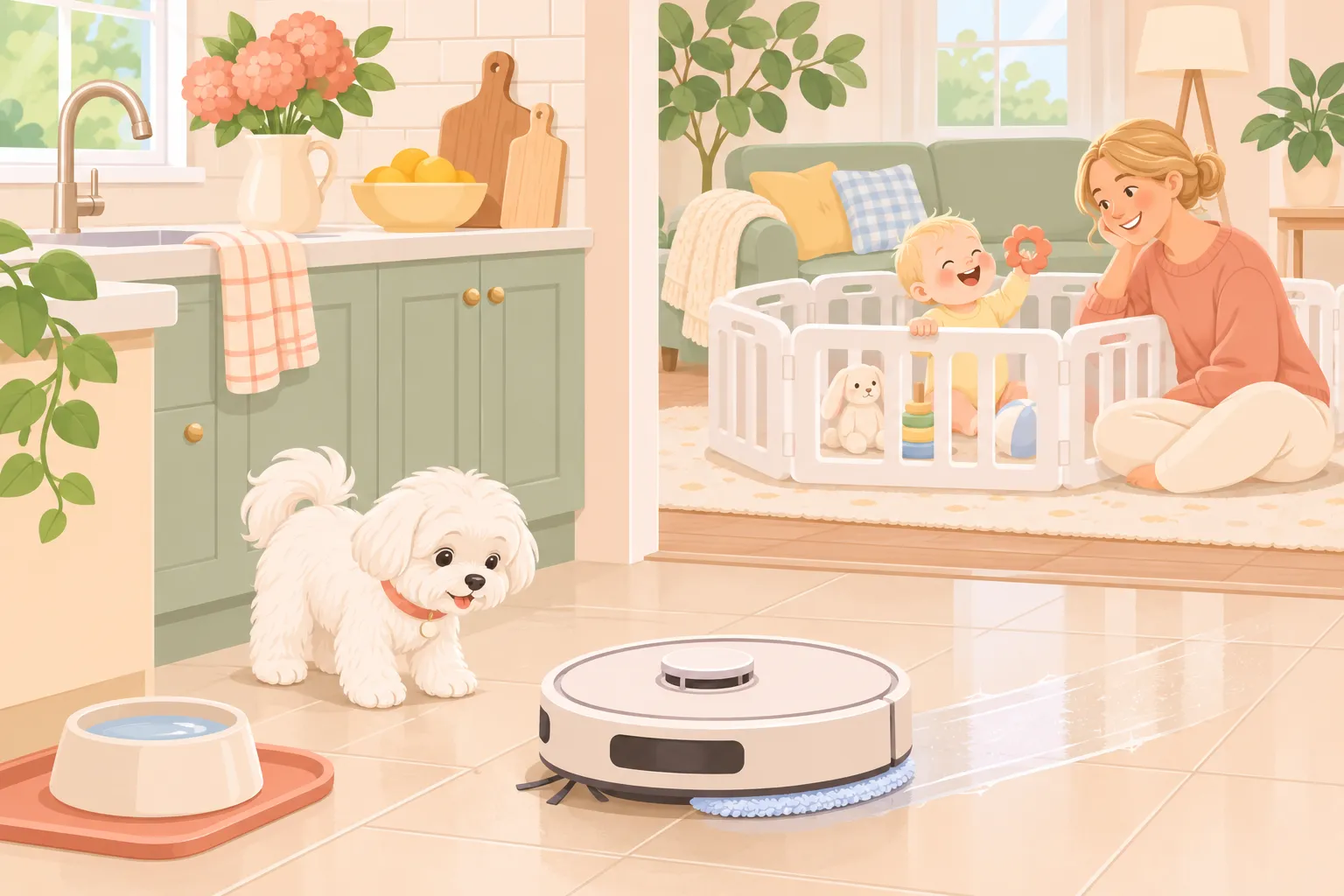
- Roborock Q7 M5+: vacuums and mops, with adjustable water flow. You attach the mop module and fill its tank by hand. TechGearLab rated its mopping as a strength for the price.
In a home where the high-chair zone and the dog’s water-bowl corner need regular wiping, a robot that mops can save a lot of daily effort. Sources disagree on whether the Q7’s mop lifts over carpet, so remove the mop module before carpet runs.
Difference #3: dog hair — the honest part
Both makers market anti-tangle features — Shark’s self-cleaning brushroll, Roborock’s JawScrapers main brush and “0% hair-tangling” side brush — but independent testers still found long dog hair a weak spot:
- Shark: RTINGS scored the closely related AV2501S about 5/10 for pet-hair pickup, with low-pile carpet the hardest surface. Vacuum Wars noted that with longer hair you’ll still need to keep the brush clean regularly.
- Roborock: TechGearLab rated pet hair the Q7 M5+‘s weakest category, with long fur wrapping the roller; Vacuum Wars reported long-hair wrap on the closely related Q7 M5.
What this means: both can handle daily light shedding and crumbs if you check and clear the brush regularly. Neither is the right buy for a husky, a golden or a double-coated heavy shedder — for that, our eufy C28 vs. E25 comparison covers robots that scored well on pet hair.
Difference #4: runtime and price
- Shark: up to 120 minutes of runtime with recharge-and-resume, per Shark’s listing (Vacuum Wars’ review lists a shorter figure, about 80 minutes), at around $290.
- Roborock: around $200, with its listing rating the battery at up to 150 minutes.
For most homes, either covers a full clean. The roughly $90 gap is mostly the bagless HEPA base on one side and the mop on the other.
Carpet, hard floors and the mop
The two robots split along floor type as much as anything:
- Mostly hard floors with a high chair and a water bowl? The Roborock’s mop handles the daily sticky layer, and its vacuum keeps up with crumbs. Remove the mop module before it reaches rugs.
- Mostly carpet and rugs? A mop adds little, and the Shark’s vacuum-only design and bagless HEPA base are the simpler package — with the pet-hair caveat above.
- A mix? Use no-go zones to keep the Roborock’s mop off rugs, or schedule mopping runs only for the kitchen.
Running costs to plan for
Both robots have ongoing costs beyond the sticker price:
- Roborock: replacement dust bags for the dock, plus brushes and the mop pad over time.
- Shark: no bags, but filters and brushes over time, and the base bin to empty yourself.
- Both: side brushes wear faster in a home where they spend their days pulling dog hair out of corners.
Check current prices for genuine replacement parts before you buy; they’re part of the real cost of owning either robot.
Mapping a dog-and-baby home
The first mapping run sets you up for months, so a little prep pays off:
- Pick up the floor first — toys, socks, the dog’s rope toy and phone cables — so the robot maps the room, not the clutter.
- Close the nursery door during mapping and cleaning if you don’t want the robot (or its dock noise) near naps.
- Draw no-go zones around the water bowl, the play mat and any rug fringe the robot tends to eat.
- Re-run the map after you move furniture for the baby — a new crib, a play yard or a changing table changes the layout.
The dog-and-baby routine (either robot)
- Run it after the dog’s walk, not before — neither listing promises accident avoidance.
- Do a quick floor check for socks, small toys and cables.
- Set no-go zones around the water bowl and the play mat.
- Clear the brush every few runs in shedding season.
- Keep the dock away from the nursery, and schedule cleans that end outside nap time — self-empty cycles are loud. TechGearLab measured the Roborock’s at about 71 dB.
Which fits which home?
- Choose the Shark AV2501AE if you want a bagless, HEPA-filtered base, only need vacuuming, and your dog is a light shedder.
- Choose the Roborock Q7 M5+ if you want vacuuming and mopping at the lower price, and your dog is a light shedder.
- If you have a heavy, long-coated shedder, compare robots that tested well on pet hair before choosing either.
Put plainly
These are two good budget robots with the same blind spot. Pick by the dock and the mop — bagless HEPA for the Shark, mopping and the lower price for the Roborock — and be honest about your dog’s coat before you pick either. Our Roborock Q7 M5+ guide and best robot vacuums for dog hair go deeper.
Sources
- Shark AV2501AE and Roborock Q7 M5+ product listings (docks, filtration, runtime, mopping).
- RTINGS: Shark AI Ultra Robot (AV2501AE/AV2501S family) review
- Vacuum Wars: Shark AI Self-Empty XL (AV2501AE) review
- TechGearLab: Roborock Q7 M5+ review
- Vacuum Wars: Roborock Q7 M5 and M5+ review
- RoboVacGuide: eufy E25 vs. C28 (pet-hair results)
Our picks at a glance
Shark AV2501AE AI Ultra Robot Vacuum with XL HEPA Self-Empty Base
What stands out
- Bagless self-empty base that Shark says holds up to 60 days of debris
- True HEPA filtration in the base, per Shark, plus a self-cleaning brushroll
- In Vacuum Wars’ testing with cat hair, the base emptied the bin in almost every case
Things to know
- RTINGS scored the closely related AV2501S about 5/10 for pet-hair pickup, struggling most on low-pile carpet
- Vacuum only — no mopping on this model
Roborock Q7 M5+ Robot Vacuum and Mop with Self-Empty Dock
What stands out
- Self-empty dock with a 2.7 L bag rated for up to 7–9 weeks, per the listing
- Vacuums and mops, with adjustable water levels
- Independent testers rate its mopping as a strength for the price
Things to know
- Independent testers found long dog hair wraps the brush and rated pet hair its weakest category
- Dust bags are an ongoing cost
Questions families actually ask
Which is better for dog hair, the Shark AV2501AE or the Roborock Q7 M5+?
Neither is a dog-hair specialist. Independent testers rated pet-hair pickup as a weak spot for both — RTINGS scored the closely related Shark AV2501S about 5/10 for pet-hair pickup, and TechGearLab rated pet hair the Q7 M5+’s weakest category. For a heavy shedder, compare robots that tested well on pet hair — for example, the eufy Omni C28 scored 100% on pet hair in test results summarized by RoboVacGuide.
Bagless or bags — which is better in a dog home?
It’s a trade-off. The Shark’s bagless base means no bags to buy, but you empty the base bin yourself every so often. The Roborock’s sealed bags cost money but keep dust and dander contained when you change them, which some allergy-conscious families prefer.
Do either of these avoid dog accidents?
Don’t count on it. Both navigate with LiDAR and neither listing mentions a camera for recognizing small objects on the floor. Run them after the dog’s walk and check the floor first.
Will the self-empty dock wake the baby?
Self-empty docks are loud for a few seconds. TechGearLab measured the Roborock’s auto-empty at about 71 dB. Schedule cleans that end outside nap time and keep the dock away from the nursery.