How to Get Old Dog Urine Smell Out of Carpet—Safely Around a Crawling Baby
Reader-supported — if you buy through our links we may earn a commission, at no extra cost to you. As an Amazon Associate I earn from qualifying purchases. Details
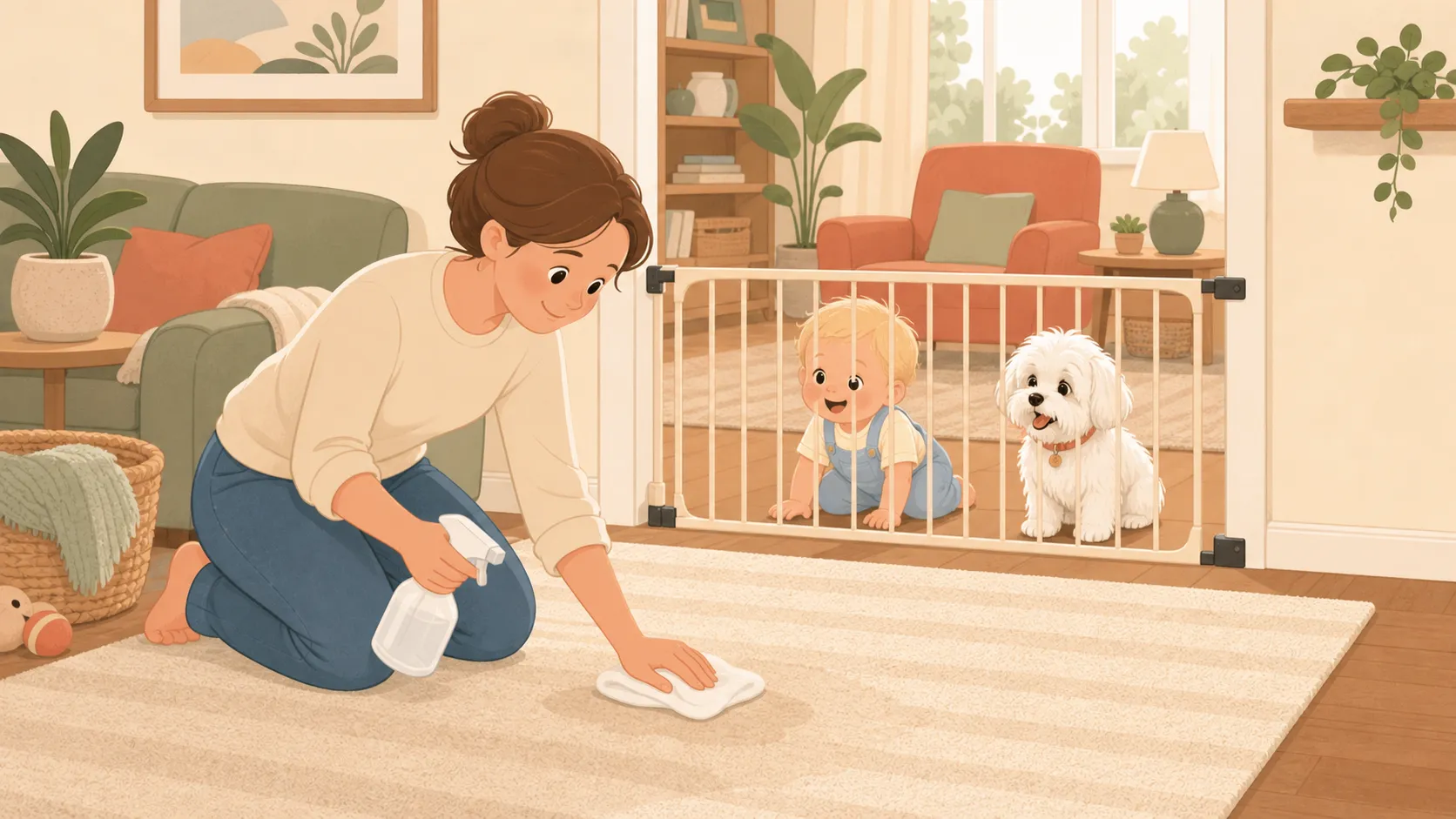
An old urine smell is rarely sitting only on the carpet fibers you can see. The original accident may have passed through the face yarn, backing, pad, and sometimes the subfloor. A light spray can make the top smell better for an afternoon while leaving the actual source untouched. When humidity rises—or a baby starts crawling with their face inches from the floor—the odor seems to “come back.”
The fix is not a stronger perfume. It is finding the whole spot, getting an enzyme cleaner to the same depth as the urine, giving it the labeled dwell time, and keeping the wet zone completely unavailable to children and pets until it is dry.
We have not tested these cleaners ourselves. This guide follows current manufacturer directions and independent animal-welfare cleaning guidance. “Safely around a baby” here means controlled storage, label-directed use, and no access to the treated area while it is wet—not a claim that a cleaning product is harmless to touch or mouth.
What you need
- A UV flashlight if the spot is hard to locate; it can help map likely old contamination, though not every glow is urine.
- White absorbent towels, cool water, gloves, and a baby gate or a door that closes.
- One enzyme cleaner—not a cocktail of enzyme spray, vinegar, bleach, detergent, and deodorizer.
- A wet extractor only if its instructions and the cleaner label allow the way you plan to use it. Pre-treating and later extracting is different from pouring a spot formula into the machine tank.
Our enzyme-cleaner comparison covers four formulas. For this particular job, Rocco & Roxie and Nature’s Miracle Advanced stand out because both brands publish detailed directions for deep or old odor.
Which of the two bottles fits this job?
Choose based on method and scale, not a claim that one formula is universally stronger. Rocco & Roxie is the straightforward spot-treatment choice when you have one or two mapped areas and want the brand’s dried-spot instructions. The verified 32-ounce Amazon listing is easy to handle, but a large pad-deep patch can use much more liquid than a surface spray suggests.
Nature’s Miracle Advanced is the better fit when you want a label with precise steps for full-strength use, a 15-minute stain dwell, a 24-hour dry, and a separate covered method for severe old odor. Larger sizes are easier to find for multiple rooms. Its current ingredient list includes fragrance and isopropyl alcohol, so a fragrance-sensitive household should not assume “enzymatic” means odorless.
Do not apply both to the same wet spot to hedge your bet. Start with one bottle, record what you used and when, and complete its process through the final dry. If it fails, that record tells you whether the likely problem is coverage, depth, or the material below—not merely that you need a third scent on top.
Build a clean path through the room
Before treatment, decide where your clean towels, used towels, shoes, and extractor will go. A baby gate protects the treated square, but it does not help if a damp towel is dropped beside the toy basket or the extractor hose drags across the crawl area. Work from the clean side toward the spot, bag used disposable towels immediately, and move washable towels straight to the laundry.
If the baby normally crawls through that doorway, create an alternate route before you start. A pad-deep enzyme treatment is not an ideal naptime gamble: the area may still be wet when the household needs it again. Starting after the baby’s last use of the room gives the product its full dwell and dry time without pressure to reopen early.
Step 1: find the true boundary
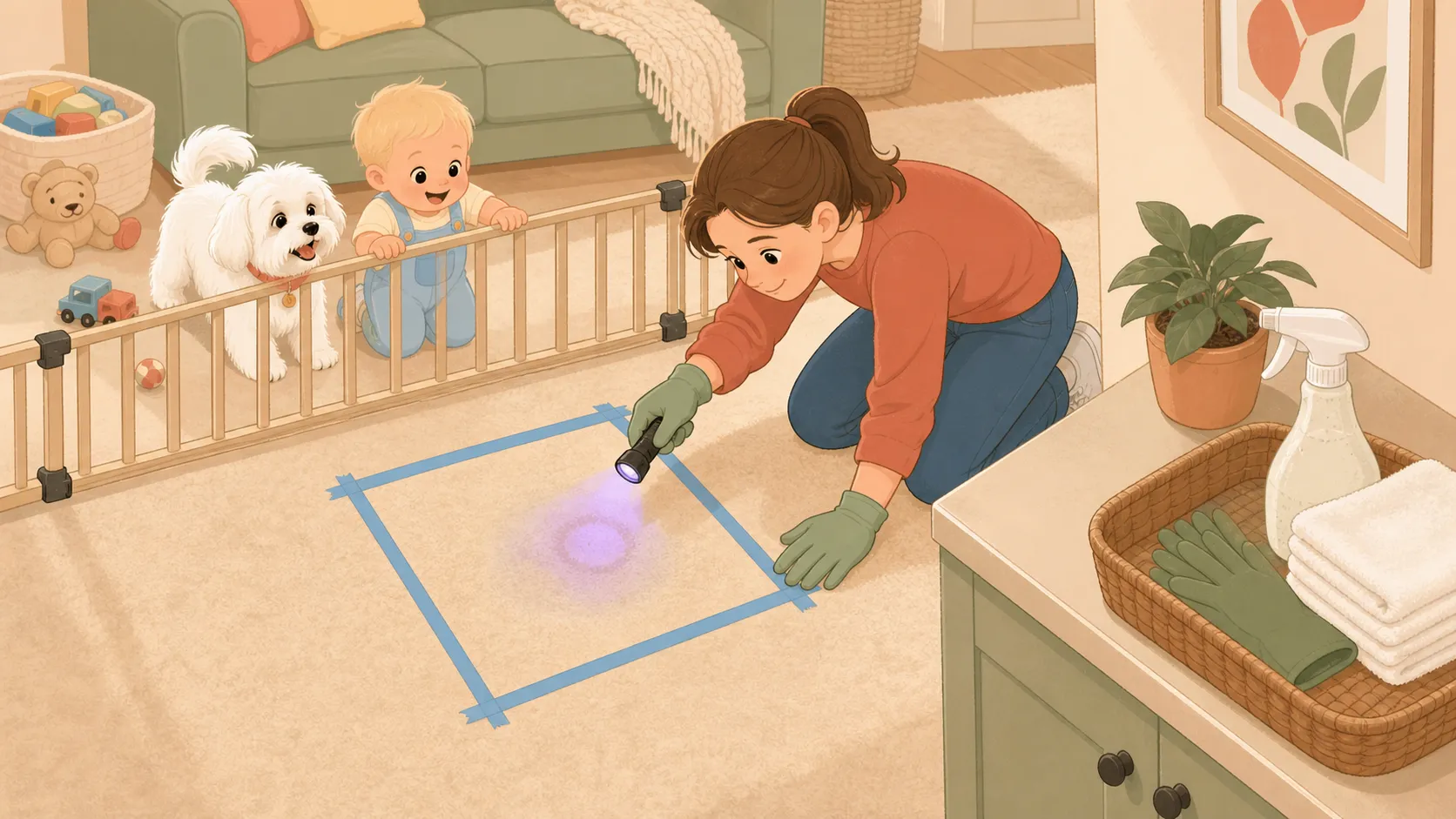
Start with your nose and sight, then inspect after dark with a UV flashlight if necessary. Humane World recommends checking closely and lightly outlining suspected old spots. Mark just outside the visible or glowing edge with removable tape. Urine spreads as it moves downward, so the pad-level footprint may be wider than the mark on top.
Before applying anything, test the cleaner on a hidden patch and wait for the label’s full test period. Nature’s Miracle currently says to wait one hour before checking for color transfer. Wool rugs and specialty fibers are not ordinary wall-to-wall carpet; use the care label or a professional rather than assuming a pet spray belongs on them.
Step 2: remove what can still be extracted
If the area was previously treated with soap or a deodorizer, rinse sparingly with cool water and blot or extract. Do not flood the room indiscriminately—the point is to reduce incompatible residue without spreading the contamination.
Skip steam. Humane World warns that heat can bind urine proteins into man-made fibers and set both stain and odor. Also skip ammonia-based products; their odor can resemble a urine cue to a dog. This is one of those jobs where more chemistry is not more cleaning.
Step 3: saturate to the depth of the accident
Apply one enzyme cleaner at full label strength. The most common failure is treating a pad-deep accident like a surface stain.
Rocco & Roxie’s instructions say the solution must contact the urine and penetrate the carpet, pad, or subfloor that the urine reached. Its guidance allows older dried spots a long dwell—up to overnight—before blotting or extraction. Nature’s Miracle Advanced similarly says saturation is essential and that carpet may need to be lifted so product can reach the pad and floor. Its odor directions say to leave the treated area wet and let it air-dry; for severe old odors, the label calls for a water-saturated towel over the treated area for one to two hours.
Those are different label methods. Pick the bottle you are using and follow that bottle—not an improvised average of both.
Step 4: make the wet zone impossible to enter
This is the baby-specific step most cleaning advice skips. Set the gate before the bottle opens. Move play mats, floor toys, pacifiers, and anything else likely to be mouthed out of the room. Store the cleaner upright and out of reach as soon as you finish applying it.
Nature’s Miracle explicitly directs people and pets to stay off the treated area until it has dried. “Dry” should include the layer you saturated, not only the carpet tips. A pad-deep treatment may need a day or longer depending on airflow, carpet thickness, and how much liquid was required. Ventilate the room without aiming a heater at the spot, and do not cover it with a baby play mat to reopen the room early.
Step 5: judge only after a complete dry
Enzyme treatment can smell different while wet. Wait until the area has dried fully, then smell it at floor level. Blot or extract only when the product directions call for it; vacuum after drying if the label recommends it.
If the odor remains, repeat once with the same correctly applied product rather than immediately layering on fragrance. A smaller residual smell often means part of the boundary or depth was missed. An unchanged smell after thorough, repeated treatment suggests urine is in the pad, tack strip, baseboard, or subfloor.
When cleaning is no longer the honest answer
If several accidents soaked the same area, the carpet pad may be the odor reservoir. Humane World notes that some cases require replacing sections of carpet and padding. A professional can lift the carpet, identify the affected layers, and tell you whether sealing or replacing a small subfloor section is warranted. Endless surface spraying can cost more than fixing the layer that is actually contaminated.
Also address why the accident happened. A single missed potty break is one thing; new or repeated house-soiling—especially with discomfort, increased thirst, or a senior dog—deserves a veterinary conversation. Cleaning removes the scent cue, but it cannot treat a urinary or mobility problem.
The short version
Find the full spot, test the carpet, avoid steam and mixed cleaners, saturate an enzyme formula to the same depth as the urine, and fence the area off until every treated layer is dry. If the smell survives two correct applications, stop buying spray bottles and inspect the pad. That is less glamorous than a “one weird trick,” but it is how you remove the source without turning a crawling baby loose on a wet treatment zone.
Sources consulted
- Nature’s Miracle Advanced Stain & Odor Eliminator: ingredients and directions
- Rocco & Roxie stain and odor instructions
- Humane World: removing pet stains and odors
Last verified: August 28, 2026.
Our picks at a glance
Rocco & Roxie Stain & Odor Eliminator (32 fl oz)
What stands out
- The maker gives specific directions for dried spots and says the liquid must reach the carpet pad or subfloor when the urine did
- A practical spray-bottle format for one or two old spots rather than a whole-room treatment
- The verified Amazon SKU is labeled for urine and other organic pet stains
Things to know
- The treated zone has to stay wet long enough to work, then remain off-limits until fully dry
- A 32-ounce bottle can disappear quickly when a large spot needs true pad-deep saturation
- You still need a colorfastness test, and repeated contamination may require carpet or pad replacement
Nature's Miracle Advanced Stain & Odor Eliminator for Dogs
What stands out
- The current label gives unusually clear saturation, dwell-time, and 24-hour drying directions
- The manufacturer says its enzymatic activity continues while bio-based material remains
- Widely available in larger sizes when several old spots need treatment
Things to know
- The fresh fragrance may be more noticeable than a low-scent household wants
- The label excludes untreated hardwood, leather, suede, silk, and wool specialty fabrics
- People and pets must stay off the area until it has dried
Questions families actually ask
Can a crawling baby go back on the carpet after enzyme cleaner?
Follow the exact product label. Nature’s Miracle says people and pets should stay off the treated area until it has dried; a baby gate or closed door is the simplest way to enforce that. Do not call the carpet ready because the surface merely feels less wet—deep saturation can leave the pad damp much longer.
Why does the smell return after the carpet dries?
The liquid may have reached the pad or subfloor while the cleaner only reached the carpet face. Humidity can make that hidden residue noticeable again. Re-treat deeply enough to reach the source; if repeated treatment fails, a carpet professional may need to lift the carpet and assess the pad.
Should I use a steam cleaner on old dog urine?
Not as the first response. Humane World advises against steam on urine because heat can set the stain and odor into synthetic fibers. Use cool water for extraction and a label-directed enzyme treatment instead.
Can I mix enzyme cleaner with vinegar, bleach, or another cleaner?
No. Use one product exactly as labeled. Nature’s Miracle specifically says to use its formula first because other cleaners or detergents may set the stain, and mixing household chemicals can create additional risks. If another product was already used, rinse or extract it and let the area dry before deciding on the next label-directed step.