PetSafe Automatic Ball Launcher: A Plain Guide for Dog-and-Baby Homes
Reader-supported — if you buy through our links we may earn a commission, at no extra cost to you. As an Amazon Associate I earn from qualifying purchases. Details

The PetSafe Automatic Ball Launcher is a machine that plays fetch for you: the dog drops a tennis ball into the funnel, the machine beeps, and it fires the ball back out across the yard, over and over, no arm required. For a ball-obsessed dog and a parent whose arms are permanently full, that pitch is almost too good — so it’s worth being clear-eyed, because this is a genuinely useful product with a genuinely polarizing reputation. Owner reviews split hard — a devoted camp and a frustrated one — and the reasons are consistent.
We haven’t tested this ourselves — this guide is built from the spec sheet, the manufacturer’s safety documentation, and the patterns across hundreds of owner reviews. Where owners and the spec sheet disagree, we say so.
How it works
You set two dials: distance and angle. The launcher throws roughly 8 to 30 feet across nine distance steps and six angle settings, so you can dial in a short indoor hallway lob or a long backyard bomb. It runs on 6 D-cell batteries for cordless play or the included AC adapter when you’ve got an outlet, holds up to three balls, and ships with two standard PetSafe tennis balls. It’s built for dogs that can pick up and drop a standard tennis ball (about 2 5/8 inches) — and note this full-size model uses standard-size balls only, not the smaller mini balls that some small-dog machines take.
The safety design is the part owners respect most. Per PetSafe, a motion sensor won’t fire if a dog is within about 7 feet of the funnel — that’s a dog-safety feature, not validated child protection, so keep a baby well clear regardless. A tone sounds before every launch, and the machine forces a rest: PetSafe lists roughly a 15-minute time-out, with a sleep mode after about 30 minutes of play, so a dog who would fetch until it collapsed doesn’t.
Why a dog-and-baby home is the use case (and its limits)
The appeal writes itself. There are stretches — a feed, a diaper change, a fussy baby who only settles while you walk laps — when you physically cannot throw a ball, and the dog still has a tank of energy that’s about to become your problem. A launcher lets the dog burn that energy itself in the yard while your hands stay full.
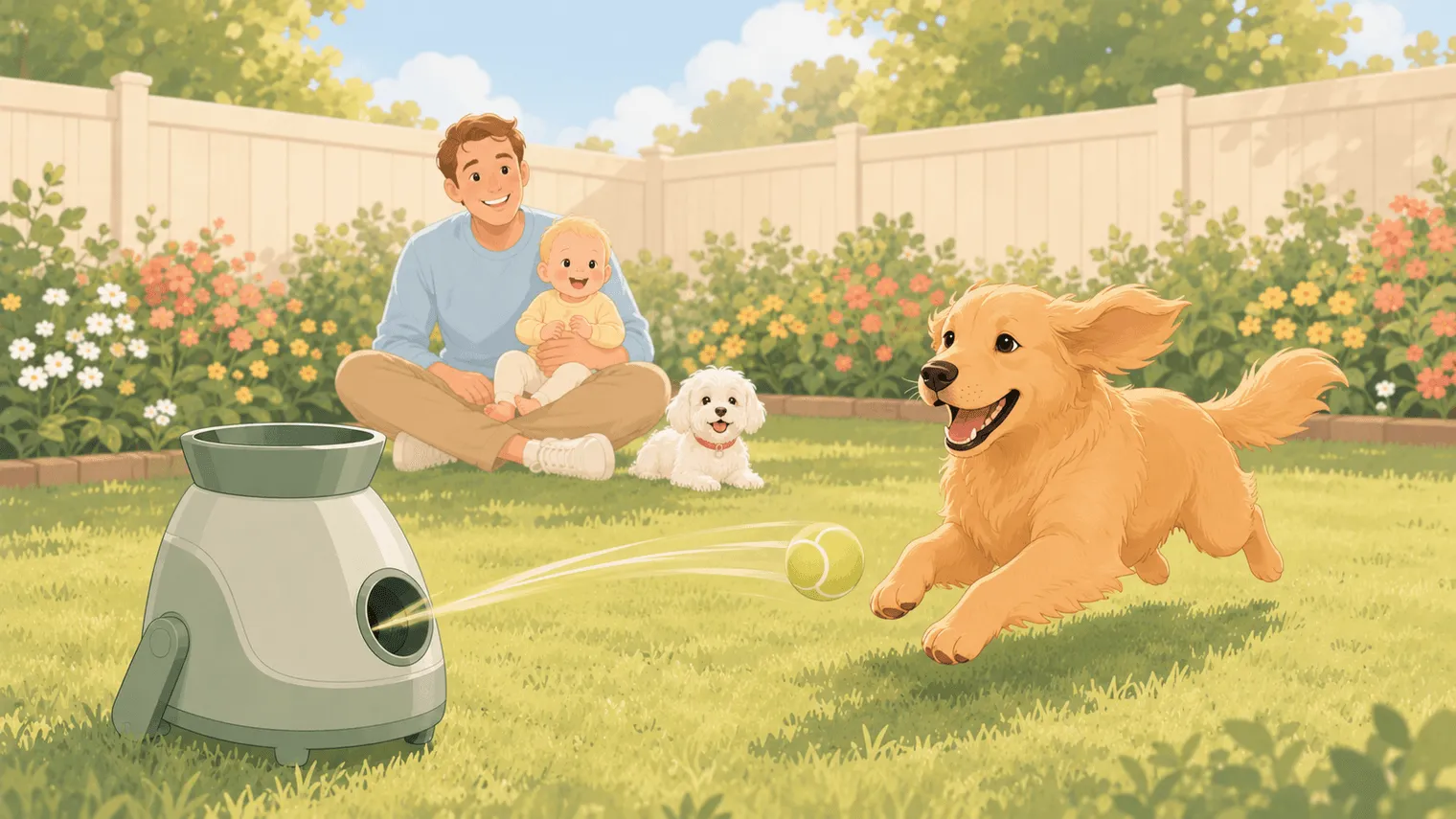
The limit is noise, and it’s a real one for this audience. Owners consistently describe the beep-then-thunk as loud — it’s the very thing that startles dogs at first — so assume it carries indoors and can wake a napping baby through an open window. This is an outdoor, daytime, away-from-the-nursery toy, not something to run quietly during nap time. And because it fires a fast ball, the 7-foot no-launch zone is a rule, not a suggestion: the child stays inside or well clear while it’s running, and the loose tennis balls get picked up and gated away after, the way you’d keep any small pet toy from a crawler.
What owners consistently like
For the right dog, owners are genuinely delighted. High-energy breeds get a level of self-directed exercise that’s hard to deliver by hand, and owners love reclaiming the half-hour they used to spend as a throwing machine. The safety features get specific praise: the front sensor refusing to fire at a dog standing in the splash zone, and the forced rest cycle that saves a maniac from himself. The dual power and water-resistant build also land well — D batteries out at the far end of the yard, the adapter on the porch, rain not a crisis.
Things to know before you buy
Two caveats show up again and again, and together they explain the mixed owner reception. The first is the noise: the pre-launch beeps and the launch sound scare a lot of dogs on day one, and owners report it takes days of patient, treat-paved acclimation — with some dogs never coming around at all. The second is the training: the machine will happily launch, but many dogs won’t drop the ball into the funnel on their own. They’d rather bring it to a person, which is the whole thing you were trying to outsource. Owners who succeed put in real reps teaching “carry it back, drop it in the hole,” and they’re candid that results vary by dog.

Smaller gripes round it out: the motion sensor can be finicky if the dog waits off to the side or stands too close, the forced 15-minute timeout frustrates owners mid-play, the fairly light unit can shift or tip after a throw, and it’s standard-ball-only. None of these is a defect so much as a “know what you’re buying” — this is a capable machine that rewards a ball-driven, trainable dog and disappoints an anxious or uninterested one.
Put plainly
If your dog is ball-obsessed, sound-tolerant, and willing to learn the drop-in-the-funnel game, owners are thrilled with it — it buys back the exercise shift on exactly the days a new baby eats all your hands. Go in expecting a training project, run it outside and away from nap time, and respect the no-launch zone around the baby. If your dog spooks at noise, won’t release the ball, or you mostly play quiet fetch during naps, save the money and the frustration and use a manual Chuckit instead — same fetch, none of the beeps.
At a glance
PetSafe Automatic Ball Launcher
What stands out
- Owners with high-energy dogs say the distance and angle range genuinely tires the dog out hands-free, in the yard or a long hallway
- Owners praise the safety design: a front sensor won't fire at a dog in the way, and a forced rest cycle stops a ball-obsessed dog from overdoing it
- Runs on 6 D batteries for cordless yard use or the included AC adapter indoors, and the body is water-resistant
Things to know
- The most common complaint by far: the pre-launch beeps and the launch thunk startle many dogs at first, and owners report some never warm up to it
- Plenty of dogs won't drop the ball into the funnel on their own — owners say it takes real training and results vary a lot by dog
- Owners find the motion sensor finicky and the roughly 15-minute forced rest frustrating; the light unit can shift or tip, and it takes standard-size tennis balls only
Questions families actually ask
Will my dog actually use it by itself?
Some dogs get it in a day; many need patient training, and a few never buy in. The machine's job is to launch — teaching the dog to carry the ball back and drop it into the funnel is on you, and owners report that's the make-or-break step. Dogs who already love a ball and know 'drop it' adapt fastest.
Is it too loud for a house with a napping baby?
Likely yes, so plan around it. The launcher sounds a warning beep and then a launch thunk, and owners report that noise is the single thing that spooks dogs at first — which tells you it isn't nap-time-quiet. Treat it as an outdoor, away-from-the-nursery toy; for quiet fetch during naps, a manual [Chuckit](/reviews/chuckit-sport-ball-launcher-review/) is the better call.
Is it safe around a baby or a toddler?
It has real safety engineering, but it still fires a fast projectile, so treat it like one. Per PetSafe, a sensor prevents a launch if a dog or obstruction is within about 7 feet of the funnel, and a tone warns before each throw. In a home with a crawler, run it only outside with the child indoors or well outside that zone, and keep the loose tennis balls out of reach of the baby, the way you would any small pet toy.
Batteries or the plug?
Both, and that's a genuine plus. It takes 6 D-cell batteries (not included) for cordless play in the middle of the yard, or the included AC adapter for a plugged-in spot on the porch or indoors. Owners who use it daily tend to run the adapter to avoid a steady diet of D batteries.