Jolly Ball Tug-n-Toss vs. Push-n-Play: Which Fits Your Dog?
Reader-supported — if you buy through our links we may earn a commission, at no extra cost to you. As an Amazon Associate I earn from qualifying purchases. Details
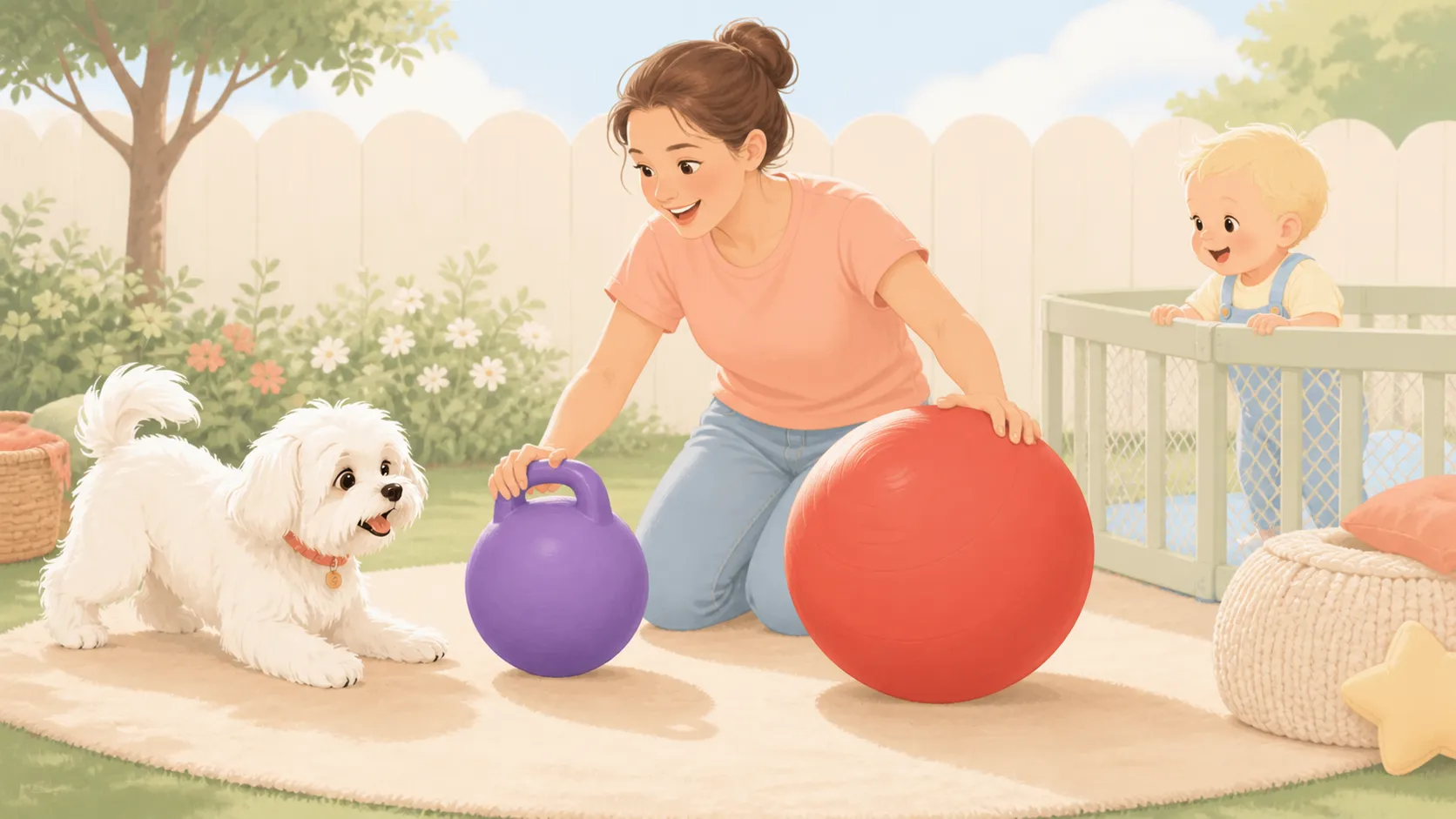
The short answer: choose the 6-inch Tug-n-Toss for a 20–60-pound dog that likes carrying, fetch, supervised tug, or water retrieval. Choose the 10-inch Push-n-Play for a dog over 60 pounds that loves pushing and herding an object it cannot easily pick up. Tug-n-Toss is the more versatile handler-and-dog toy; Push-n-Play is the more specialized, high-motion outdoor toy. Neither belongs loose beside a crawling baby.
We have not personally tested these balls. This research-based comparison uses current Jolly Pets specifications, exact US listings, and recurring patterns across owner reviews. Durability comments depend heavily on dog size, play style, surface, and supervision and are not laboratory results. Check the size and color variant before buying.
Start with the game, not the shared brand name
“Jolly Ball” is often used as if it describes one product. These two models solve different play problems. Tug-n-Toss has a molded handle and a body the dog can carry. Push-n-Play is intentionally oversized and hard, encouraging a dog to propel it across the ground.
That difference affects nearly everything: where the toy works, how loud it is, which body movements it invites, and what damage to inspect. A dog that thrives on fetch may find an ungrabbable push ball frustrating. A herding dog that wants to control motion may treat the Push-n-Play as the main event.
This comparison uses exact variants rather than mixing the line: Tug-n-Toss 6-inch Medium, Purple/Mixed Berry, ASIN B0006G56ZW, and Push-n-Play 10-inch Large, Red, model 310 RD, ASIN B0006G56YS.
Exact model comparison
| Tug-n-Toss 6-inch Medium | Push-n-Play 10-inch Large | |
|---|---|---|
| Listed dog size | 20–60 lb | Over 60 lb |
| Construction | Flexible, handled ball | Hard oversized push ball |
| Main play | Carry, fetch, tug, retrieve | Push, chase, herd |
| Inflation | Not required | Not required |
| Floats | Yes, per maker | Yes, per maker |
| Can be weighted | Not listed for this model | 10- and 14-inch sizes may be filled with water, sand, or gravel |
| Best environment | Yard, park, water; limited indoor use with space | Roomy grass yard or other controlled outdoor area |
The manufacturer describes both as durable, but durable is not indestructible. Damage can develop when the toy is used as a stationary chew instead of an interactive object. Retire any ball that sheds pieces, exposes sharp edges, or changes enough that a piece could be swallowed.
Tug-n-Toss: more ways for the handler to participate
The molded handle gives the dog an obvious pickup point and gives a person a way to throw or retrieve the toy. It also creates a tug option. That makes the Tug-n-Toss useful when engagement with the handler is the goal rather than simply turning the dog loose with a ball.
The official page says the toy holds its shape without inflation and floats. Those are practical features for a yard with a splash area or a dog that punctures inflatable balls. The 6-inch model is the Medium size for dogs in the 20–60-pound range; larger dogs should be matched to the maker’s larger size, not assumed safe with the smaller one.
The handle is also the obvious wear point. Owner discussions frequently mention dogs focusing their chewing there. Some continue using a scuffed ball under supervision; others prefer a handle-free soccer-style design for dogs that systematically remove protrusions. Inspection should be based on the actual damage, not on how long the toy “should” last.
Push-n-Play: a hard ball for driving, not carrying
The 10-inch Push-n-Play is too large for the intended dog to hold like a tennis ball. The dog moves it with the nose, chest, and paws. That can produce vigorous exercise and an outlet for dogs attracted to moving objects.
The Amazon variant and Jolly Pets guidance position this size for dogs over 60 pounds. Jolly Pets also says the 10- and 14-inch versions can be filled with water, sand, or gravel to add resistance. Adding weight changes the force of a moving ball; start unweighted, use only the maker’s method, and keep the session short enough to observe the dog’s gait and arousal.
Hard plastic is a major household-fit issue. On concrete or decking it can be loud, and repeated impact may mark walls or furniture. Grass provides a more forgiving play surface. Owners also describe enthusiastic dogs rubbing the nose while pushing. Check the muzzle during play and stop before repetitive friction becomes an injury.
The dog-and-baby play plan
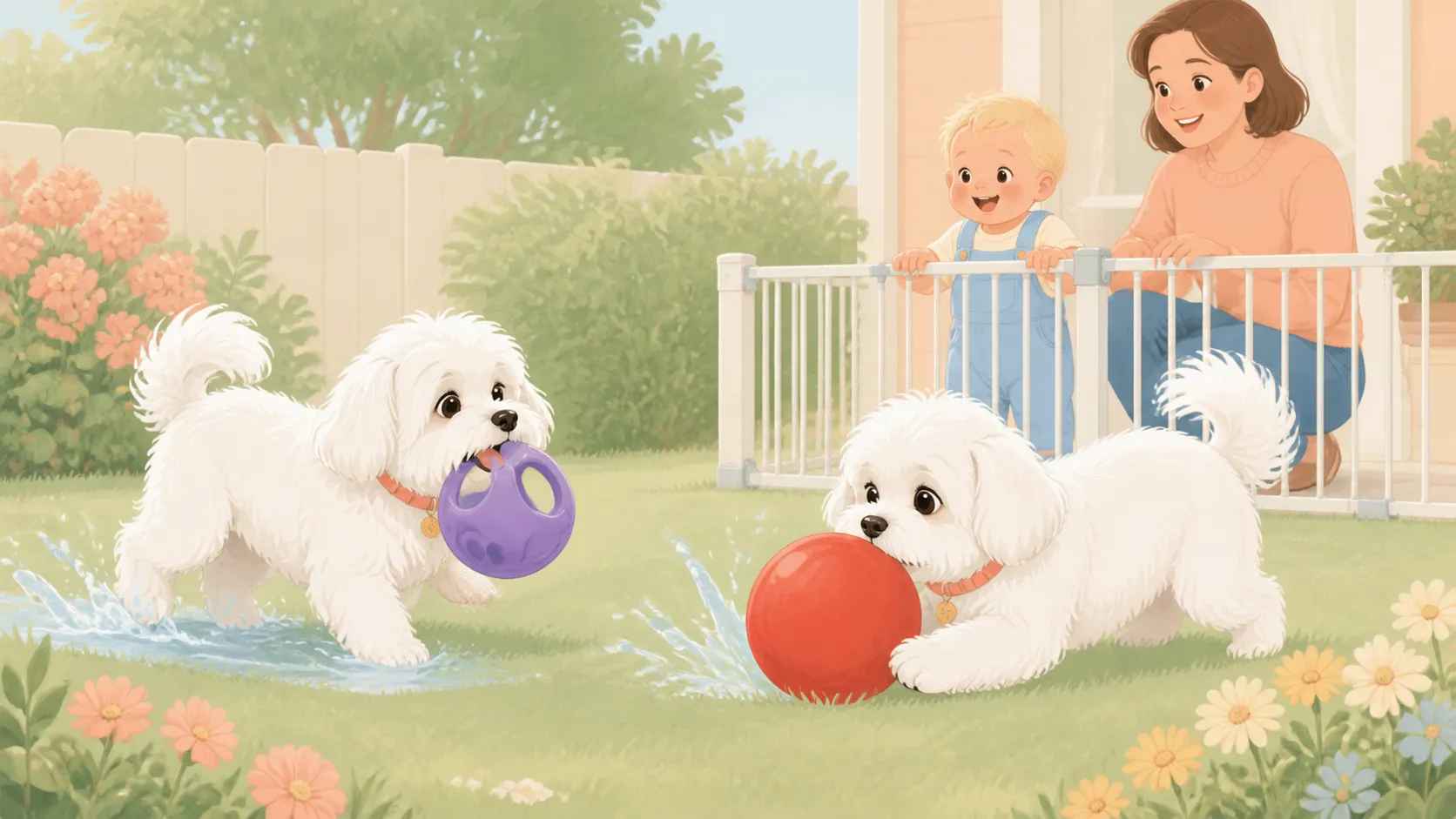
Exciting toy play changes a dog’s speed, attention, and ability to respond. The safest setup is not “be careful near the baby”; it is physical separation.
- Choose a clear play zone. Remove garden tools, bowls, low furniture, and anything a fast ball can strike. Check gates and fencing.
- Place the baby elsewhere. A fixed playpen or a caregiver-held position outside the ball’s path is preferable to relying on verbal control.
- Warm up with low intensity. Begin with short rolls or gentle throws. Avoid abrupt turns on slippery surfaces.
- Interrupt fixation. Trade the toy for food, water, or a calm cue before the dog becomes frantic. Resource-guarding signs call for professional help, not a family tug test.
- Inspect during breaks. Look for cracks, sharp edges, missing pieces, and damage around the Tug-n-Toss handle.
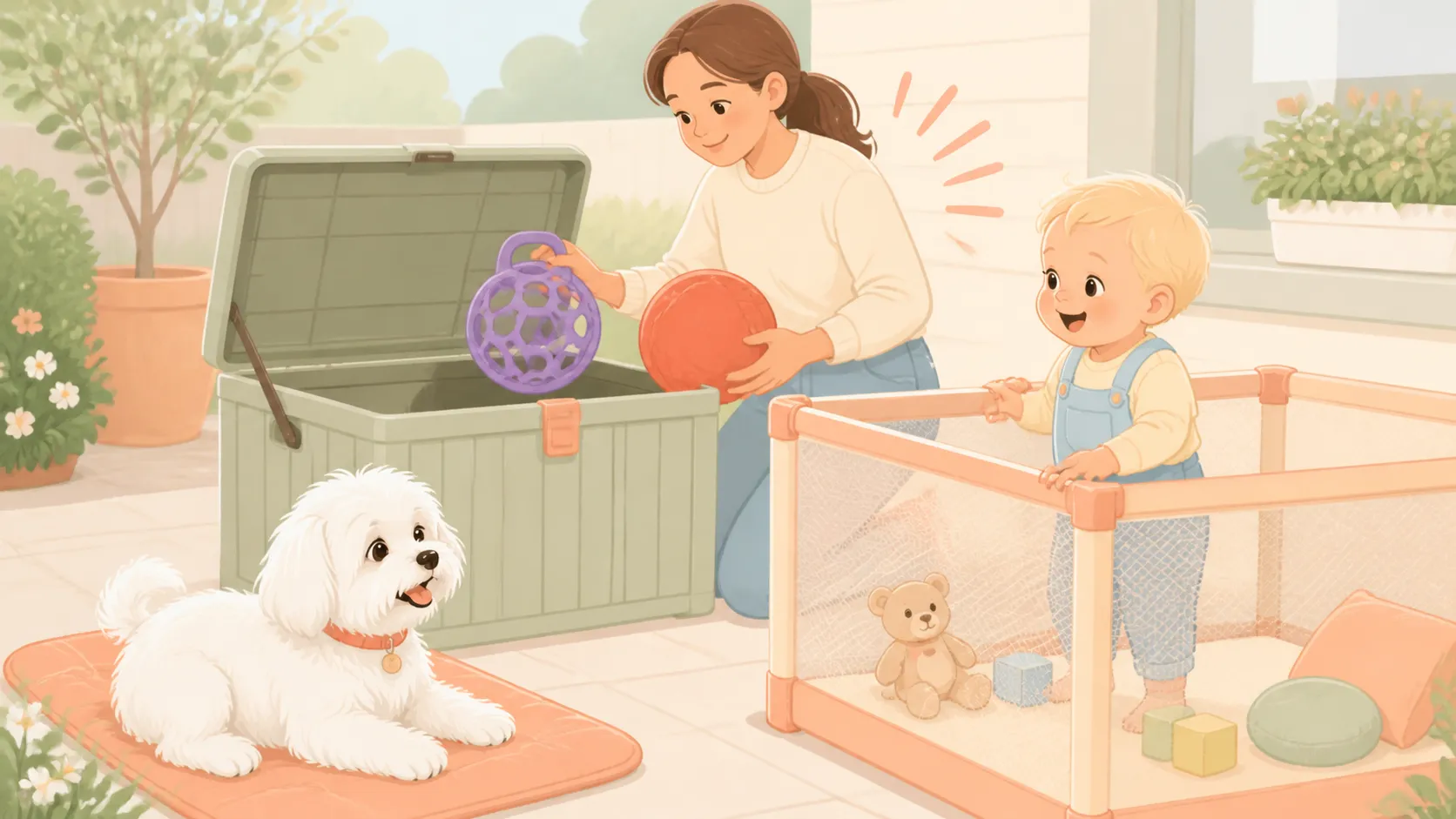
- Store the toy. End the game, pick it up, and let arousal settle before dog and baby share space again.
Water play adds another layer. A floating toy does not make a dog a safe swimmer. Use a suitable canine life jacket when appropriate, avoid currents and algae, and never let the retrieval path cross a child in the water.
Which should you choose?
Choose Tug-n-Toss when the dog is within the exact size range and you want several interactive games from one object. It is the clearer choice for a dog that naturally carries toys, enjoys handler participation, and benefits from short fetch or tug sessions. It is also likely to be less punishing to indoor surfaces, although a six-inch ball still needs room.
Choose Push-n-Play when a dog over 60 pounds has a strong, safe interest in pushing and chasing and you have a spacious grass area. It is particularly distinctive for herding-style play, but the noise, speed, and potential muzzle friction make boundaries essential.
Choose neither model if the only available space is a hard, cramped room, the dog guards large toys, or you need an item that can be left out all day. A softer supervised fetch toy, structured walk, scent game, or trainer-guided activity may fit better.
The two products do not need a winner. Tug-n-Toss asks, “Do you want to play with me?” Push-n-Play asks, “Do you have a safe field where I can drive this thing?” Answering that question honestly is better than buying by durability reputation alone.
Size and surface checks before checkout
Measure the play area as carefully as the dog. A ten-inch ball needs more than ten inches of clearance because the dog arrives behind it with momentum. Look for fence gaps, stairs, glass doors, pools, grills, and narrow corners where a dog could collide or trap the ball. On a shared lawn, remove children’s toys before the session so the dog learns a clear equipment boundary.
Then confirm the Amazon variation selector still shows the exact model. Color, diameter, scent naming, and style can move within a parent listing. The handled 6-inch Purple/Mixed Berry Tug-n-Toss is not the same item as an 8-inch model, Soccer Ball, Romp-n-Roll, or Push-n-Play. The red 10-inch Push-n-Play is the Large hard ball, model 310 RD. A photo that looks similar is not enough.
Weather changes the session too. Heat can make outdoor surfaces unsafe for paws; ice creates poor traction; a wet hard ball may move faster than expected. Use short rounds with water breaks, avoid forced repetitive sprinting, and stop for limping, torn nails, heavy distress, or unusual breathing. A toy is enrichment only while the dog’s body and behavior remain comfortable.
Sources and verification
- Jolly Pets Tug-n-Toss product page
- Jolly Pets chase and herding collection
- Jolly Pets guide describing Push-n-Play construction and weighting
- Chewy owner reviews for the Push-n-Play
- Owner discussion about handled Jolly Ball wear
- Amazon US listings for ASINs B0006G56ZW and B0006G56YS
Specifications, variants, and destinations last checked August 18, 2026. This article provides general product information, not veterinary advice.
Our picks at a glance
Jolly Pets Tug-n-Toss, 6-inch Medium, Purple
What stands out
- Molded handle supports carrying, fetching, tugging, and retrieval by the handler
- The maker says the ball does not require inflation and floats
- The 6-inch Medium listing targets dogs weighing 20–60 pounds
Things to know
- The handle can become the main chewing target for determined dogs
- It is a supervised interactive toy, not an indestructible chew item
Jolly Pets Push-n-Play, 10-inch Large, Red
What stands out
- Hard oversized ball is designed for chasing, pushing, and herding-style play
- The 10-inch model is listed for dogs over 60 pounds and floats
- The maker says 10- and 14-inch sizes can be weighted with water, sand, or gravel
Things to know
- Hard construction can be noisy on patios or indoor floors
- Obsessive pushing may irritate a dog’s nose or mouth, so sessions need limits
Questions families actually ask
What is the difference between Tug-n-Toss and Push-n-Play?
Tug-n-Toss is a handled flexible ball for carrying, fetching, tugging, and floating. Push-n-Play is a hard oversized ball that a dog drives with the nose, chest, or paws. They create different games rather than two versions of one toy.
Can a dog be left alone with a Jolly Ball?
No toy is risk-free when unsupervised. Jolly Pets directs owners to supervise play and remove a damaged toy. Inspect the handle, surface, seams, and any openings before every session.
Can these balls be used around a baby?
Use physical separation. A large moving ball, excited dog, or tug game can knock over a small child, and a dog may guard a favorite toy. Let the baby watch from behind a sturdy gate or playpen and store the ball when the session ends.
Which Jolly Ball is quieter?
The flexible Tug-n-Toss is generally the more indoor-tolerable design. The hard Push-n-Play can be loud against walls, concrete, decking, and hard floors, so it is best suited to a roomy outdoor area.