Best Air Purifiers for Pet Dander in the Nursery (2026)
Reader-supported — if you buy through our links we may earn a commission, at no extra cost to you. As an Amazon Associate I earn from qualifying purchases. Details
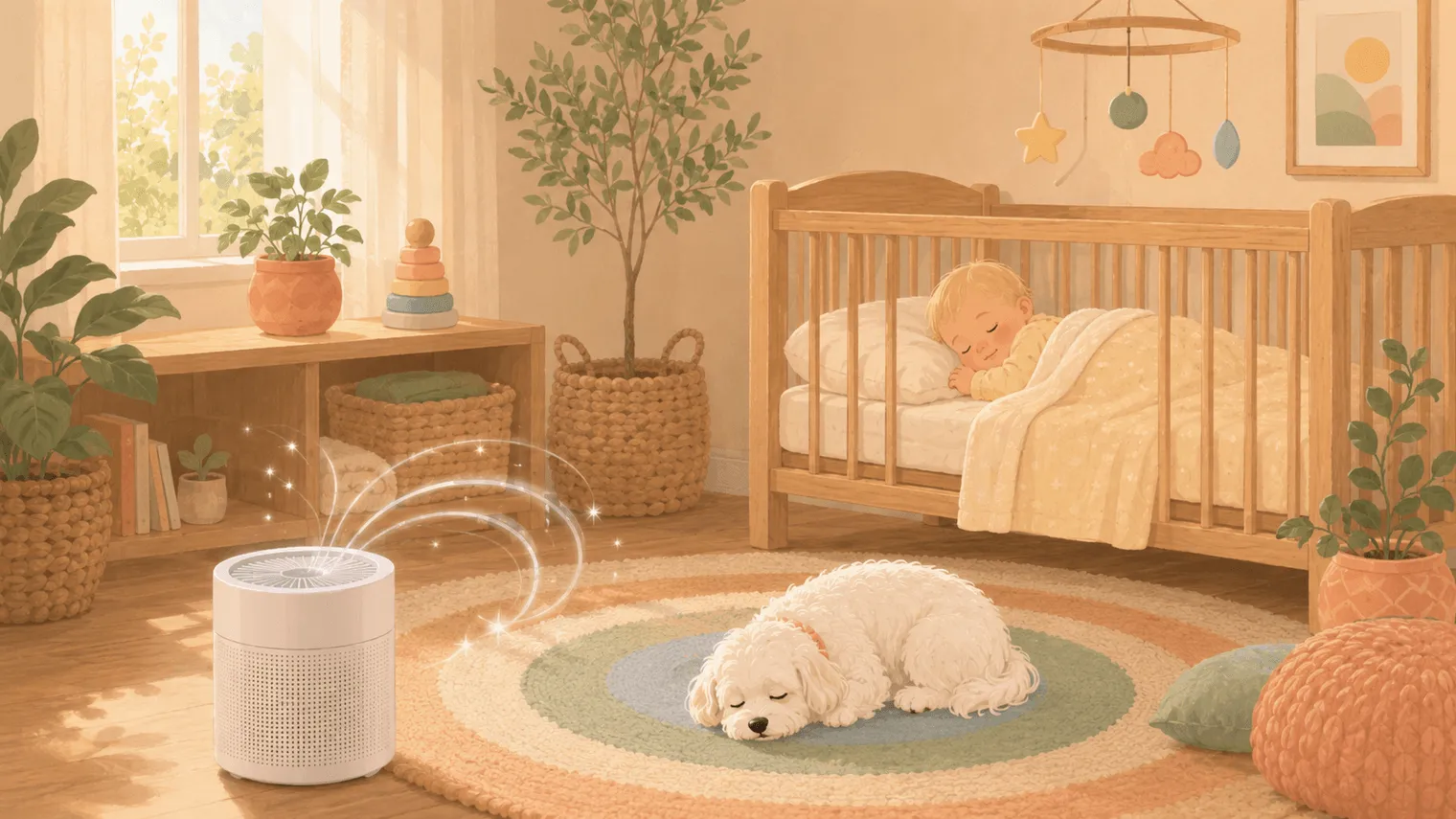
A dog’s dander doesn’t respect doorways. It rides air currents, settles into carpet, hitchhikes on socks, and eventually finds the one room you most want to keep pristine: the one with the crib. You can’t vacuum air — but you can filter it, continuously, for less than the price of a stroller accessory.
The short version: put a Levoit Core 300S in the nursery — it’s the quiet specialist — and if the budget stretches, a Winix 5500-2 (or its successor, the 5510) in whatever room hosts the most dog. Two different jobs, two honest tools.
We haven’t tested these ourselves — this guide is built from the spec sheets, published independent measurements, and the patterns across hundreds of owner reviews, including the pet-household reviewers who measure success in visible fur captured. Where owners and the spec sheet disagree, we say so.
How we chose
We compared the spec sheets and the owner-review patterns for this category; we haven’t run the field hands-on. The criteria that mattered:
- Dander capture. True HEPA filtration and the real-world pet-home performance owners describe, not marketing adjectives.
- Nursery noise. A purifier that’s too loud gets turned off, and an off purifier filters nothing.
- Running costs. Filters are the subscription nobody calls a subscription.
- Value. Street price against what owners say it actually delivers.
Levoit Core 300S: the nursery specialist
The 300S earns the crib-side spot on its quiet: Levoit rates the sleep mode at around 22 decibels, and while independent measurements run higher, owners consistently describe it as near-silent — quiet enough to fade into the baby monitor’s idle hiss. That matters because the realistic failure mode of nursery purifiers isn’t weak filtration, it’s parents shutting off a droning machine. Owners say this one fades into the background.
Filtration is true HEPA — by the EPA’s definition, at least 99.97% of particles down to 0.3 microns, which covers dander comfortably — in a footprint sized for bedrooms. The app control earns its keep in a nursery specifically: fan-speed changes and schedules happen from the hallway, not from a creaky floorboard two feet from the crib. A pet-allergy filter variant exists for heavier fur households; either way, per the spec sheet budget the $15–30 filter swap every six to eight months, because a saturated filter is just a fan with a past.
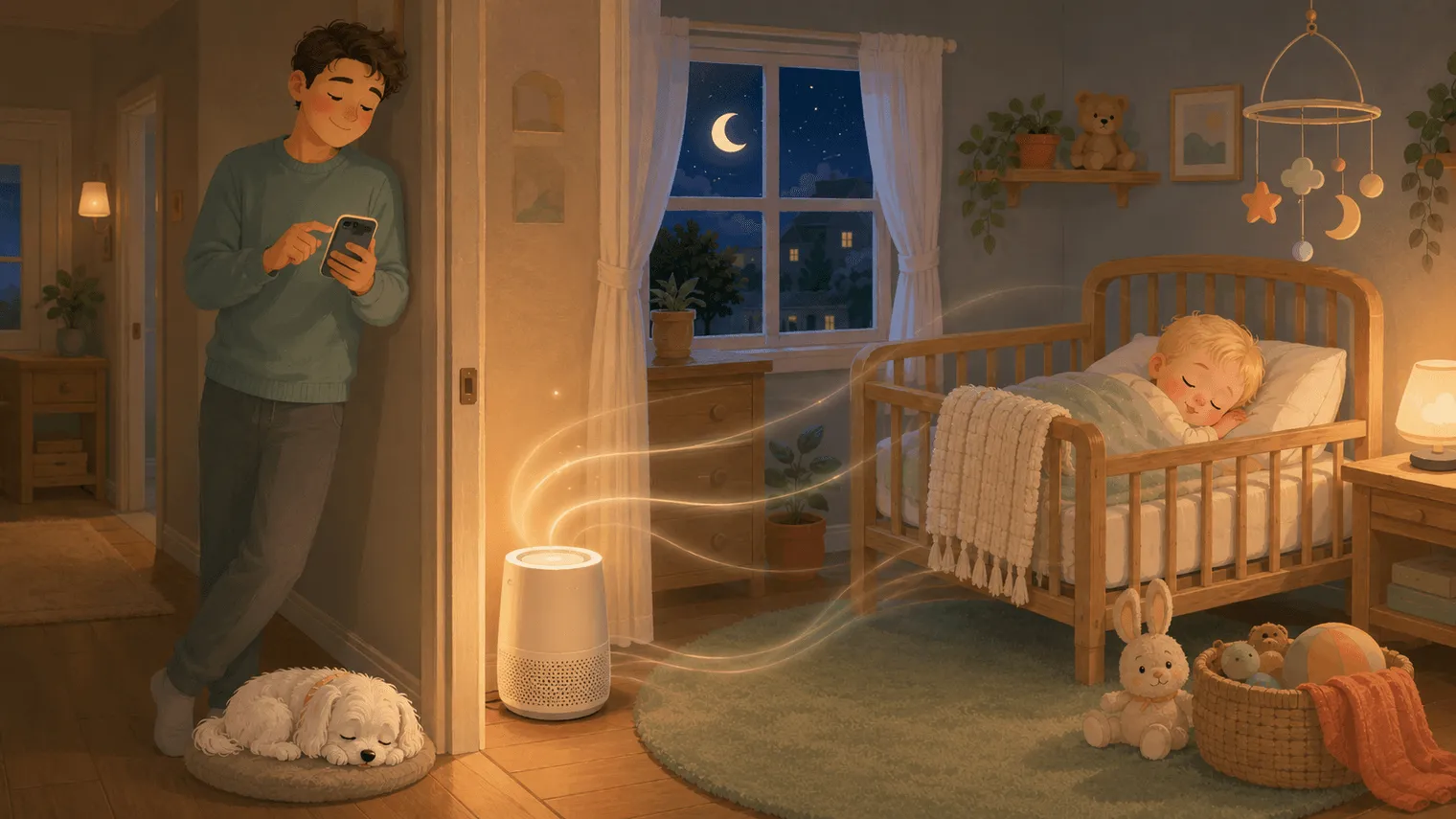
Its honest limit is reach. Owners are clear this is a one-room machine. Which brings us to the dog’s side of the house.
Winix 5500-2: the fur-room workhorse
Where the Levoit specializes, the Winix hauls. It’s built for the living room-scale spaces where the dog actually sheds, and its design is unusually friendly to pet households in two specific ways. First, a washable pre-filter catches the visible fur load — owners with multiple pets describe rinsing off a felt-like mat of hair — sparing the HEPA filter for the microscopic work. Second, the carbon odor filter is washable too, so the dog-smell layer doesn’t generate a recurring carbon-filter bill the way most rivals do.

Two things to know, stated plainly. Its PlasmaWave ionization feature divides owners — some report irritation sensitivity — and a sensible nursery-era policy is simple: it has an off switch, use it, and owners report excellent filter-only operation. And Winix has discontinued the 5500-2 in favor of the 5510 — a close successor with a slightly higher airflow rating, added Wi-Fi, and its own filter (the two filters aren’t cross-compatible) — so buy whichever is the better deal and skip any old stock priced like a collector’s item.
The placement playbook
Close the loop with ten minutes of strategy: nursery purifier near the door (where hallway air enters), dog-room purifier near the dog’s bed, both running continuously on low rather than occasionally on high — continuous turnover beats heroic bursts. Wash the dog’s bedding weekly, run the robot vacuum daily, and the purifiers stop fighting a losing land war and start winning the air.
Put plainly
If you want quiet, set-and-forget air cleaning right beside the crib, the Levoit Core 300S is the one owners keep at the nursery door. If your real problem is the living room where the dog sheds and smells, the Winix 5500-2 (or the 5510) is the workhorse, and its washable filters keep the running cost honest. Two rooms, two jobs — buy in that order, and add the second when the budget allows.
Our picks at a glance
Levoit Core 300S
What stands out
- Sleep mode runs near-silent — Levoit rates it around 22 dB, and owners describe it as easy to forget is on
- True HEPA filtration — the standard captures at least 99.97% of particles down to 0.3 microns, dander included
- App control means fan-speed changes without entering the nursery
Things to know
- Sized for bedrooms — owners note it can’t carry an open-plan living area
- Filter replacements every 6–8 months are part of the real price
Winix 5500-2
What stands out
- Washable pre-filter catches the visible fur load before it reaches the HEPA
- Washable carbon filter handles dog odor without recurring carbon purchases
- Moves enough air for living rooms, not just bedrooms
Things to know
- PlasmaWave mode divides owners — some report sensitivity; many run it off in a nursery (it has an off switch, thankfully)
- Discontinued in favor of the closely related Winix 5510 (different filter) — fine either way, just don’t overpay for old stock
Questions families actually ask
Does a newborn actually need an air purifier because of the dog?
Need is strong; benefit is real. Pet dander is a common allergen and newborn airways are tiny — a HEPA purifier is designed to reduce airborne dander, dust, and the general fug of a home with pets, and owners with pets widely report cleaner-feeling air. It's not a substitute for vacuuming and washing the dog's bedding, but it's the easiest air-quality lever you can buy.
Where should the purifier go — nursery or living room?
Where the baby sleeps first, where the dog lives second, both if budget allows. Air cleaning is per-room in practice; a purifier in the hallway helps the hallway. Our two picks map to exactly this split.
How loud is too loud for a nursery purifier?
On sleep settings you want the purifier near or below the baby's white noise machine — call it under 30 dB. Bonus: a purifier's steady hum doubles as mild sound masking, a quiet assist to the actual white noise machine we covered.
What about ionizers and PlasmaWave-type features around babies?
A conservative take: filtration is the proven part, so in a nursery many owners run pure HEPA and switch ionizer-type extras off. The [EPA notes](https://www.epa.gov/indoor-air-quality-iaq/what-are-ionizers-and-other-ozone-generating-air-cleaners) that under certain conditions ionizers and other ozone-generating air cleaners can produce ozone at levels thought harmful to health. The Winix's PlasmaWave has an off switch precisely because some owners prefer filter-only operation — use it.