Baby Gates With a Pet Door: What the 2026 Safety Rule Means for Dog-and-Baby Homes
Reader-supported — if you buy through our links we may earn a commission, at no extra cost to you. As an Amazon Associate I earn from qualifying purchases. Details
19-second summary
What the 2026 safety rule means for your home
- What changed No pet doors on new baby gates — Federal standard since July 19, 2026, for gates made after that date.
- Why, per the CPSC A pet door can let a child through — Children can escape, get stuck or climb the frame.
- Set it up: Plain children’s gate where the baby must stay out → Pet-door gates only for pet zones → Lock any pet door near the baby.
Research-based summary — not hands-on testing.
The short version: a federal safety rule that took effect on July 19, 2026 says new children’s gates and enclosures can’t have pet doors. If a gate’s job is to keep a baby out of somewhere, choose a children’s gate without a pet door. Gates with pet doors still have a place — between the dog and the cat, in areas the baby doesn’t need blocked — but they shouldn’t be the barrier between a toddler and the stairs.
This is an explainer, not a product test. It’s built from the Federal Register text of the rule, the CPSC’s guidance on gates and enclosures, product listings, and owner reports from our earlier gate guides.
For years, a gate with a little swinging cat door looked like the perfect answer for a house with a baby, a dog and a cat: the toddler and the dog stay out, the cat strolls through to the litter box. The new rule exists because safety regulators looked at that same little door and saw something else.
What changed
The CPSC’s mandatory standard for children’s gates and enclosures, 16 CFR part 1239, now incorporates ASTM F1004-25. According to the Federal Register notice published April 1, 2026, the main new requirement is that a gate “shall not include any features or openings within the gate that allow for unassisted pet entry or egress.” The rule took effect on July 19, 2026, and applies to products manufactured after that date.
In plain terms: children’s gates manufactured after July 19, 2026, can’t include a small pet door, cat flap or similar opening — though gates made before that date may still be on store shelves. The current eCFR text of part 1239 reflects the new standard.
Why regulators care
The CPSC’s notice gives three reasons:
- Children can escape through the opening or trap their heads in it, the CPSC says.
- Pet openings can exceed the gaps the standard otherwise allows. They’re designed around cats and dogs, not around keeping a small child’s torso from fitting through.
- The extra parts can become a ladder. The horizontal frame around a pet door can give a child a foothold to climb over the gate.
None of those risks is obvious from the couch — which is the kind of hazard standards exist to catch.
What it doesn’t mean
- It’s not a recall. The rule covers how new gates are made — gates manufactured after the effective date. It doesn’t require you to replace a gate you already own.
- It’s not a judgment on pet gates as pet gates. A gate sold for pets that keeps a dog out of the cat’s room is doing a different job.
- It doesn’t make every gate without a pet door safe. Fit, mounting and height still matter — a pressure-mounted gate still doesn’t belong at the top of stairs.
But the reasoning behind the rule applies to the gate already in your hallway, too. If a gate with a pet door is the only thing between a crawler and somewhere dangerous, the rule is a good prompt to rethink that setup.
Two kinds of gates, two jobs
The cleanest way to plan a dog-and-baby-and-cat home is to stop asking one gate to do everything:
- Children’s gates (no pet door) — for anywhere the baby must stay out: stairs (hardware-mounted gates only), the kitchen, the room with the dog’s food. The Regalo Easy Step (pressure-mounted; Regalo says never at the top of stairs) and the Cumbor auto-close gate (pressure or hardware mounting, per its listing) are the two we’ve covered most. (Cumbor had a January 2026 recall of a different model; our Cumbor vs. Carlson guide explains how to check your label.) Our best baby gates for dogs and best stair gates for dogs guides go deeper.
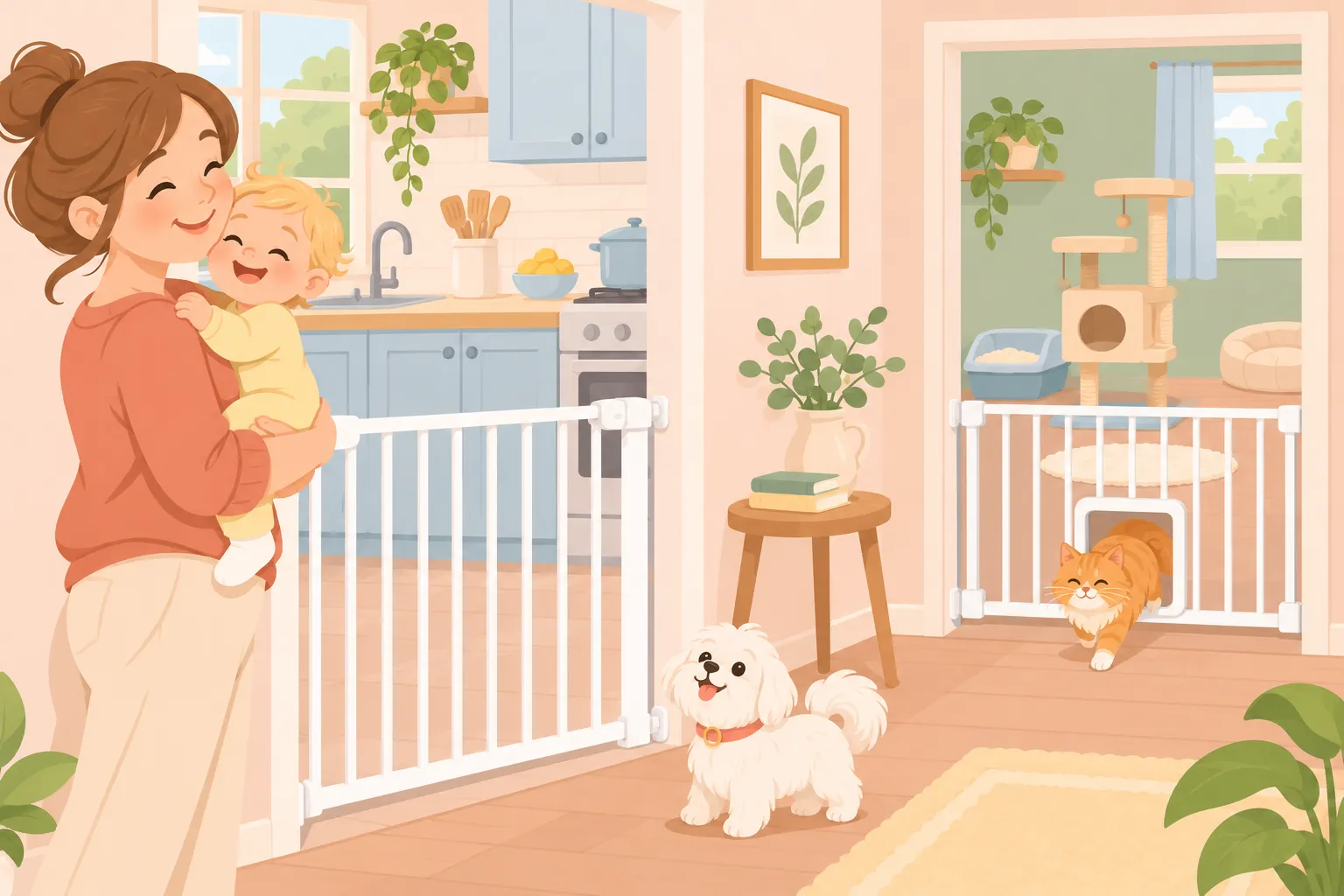
- Pet gates (pet door OK) — for zones where the goal is separating animals, not stopping a child: the dog kept out of the cat’s room, the cat given an escape route. The Carlson Extra Tall with its small pet door is that kind of gate — see our Carlson guide.
If you already own a gate with a pet door
- Ask what it’s protecting. If it’s keeping the baby from stairs, a pool, the kitchen or anything else dangerous, plan to replace it with a children’s gate without a pet door.
- Lock the pet door in the meantime if it has a lock, and supervise.
- Move it to a pet-only job. Many gates with pet doors are perfect for separating the dog from the cat in a part of the house the baby doesn’t reach.
- Check the label. Children’s gates carry labeling and instructions for use with children; follow them, including any height and age limits.
The cat question
The pet door existed to solve a real problem: getting the cat to its food and litter box without letting the dog (or toddler) in. A few setups that work without one:
- Over, not through. Many cats will hop a standard-height children’s gate, especially with a cat tree or shelf beside it. Older or less agile cats may need a different route — ask your vet.
- Feed and litter up high or in a cat-only room behind a children’s gate.
- Use the pet gate deeper in the house, where the baby doesn’t go, and keep the children’s gate where the baby does.
Put plainly
The rule is simple even if the house isn’t: children’s gates don’t get pet doors anymore. Use a plain children’s gate wherever the baby must be kept out, keep pet-door gates for animal-only zones, and if your current setup relies on a cat flap to stop a toddler, this is the nudge to change it.
Sources
General information, not legal advice.
- Federal Register: Safety Standard for Gates and Enclosures (April 1, 2026)
- eCFR: 16 CFR part 1239, current text incorporating ASTM F1004-25
- U.S. CPSC: Gates and Enclosures
- Product details and owner themes for the Regalo, Cumbor and Carlson gates as covered in our best baby gates for dogs and Carlson guides.
Our picks at a glance
Regalo Easy Step Walk-Thru Gate
What stands out
- A budget walk-through gate that many owners buy for more than one doorway
- Tool-free pressure mount goes up in minutes
- Simple lever latch opens with one hand
Things to know
- Standard ~30-inch height is low for athletic jumpers — owners size up to the extra-tall version
- Some owners report frame flex where heavy dogs lean on it daily
Cumbor Auto-Close Baby Gate (30–46")
What stands out
- Auto-close door is the feature owners mention most when both hands are full of baby
- Fits openings up to 46 inches with the included extensions
- Hold-open mode for laundry-basket hours
Things to know
- Owners report installation is alignment-fussy — the auto-close bounces if the latch side sits uneven
- Auto-close door and slow dog tails need a short introduction period
Carlson Extra Tall Walk-Thru Gate with Small Pet Door
What stands out
- 36-inch height clears jumpers that sail over standard gates, per the listing
- 7.5 × 7.75-inch pet door lets the cat through where that’s the goal, per the listing
- Pressure-mounted with wall cups and an included 4-inch extension (doesn’t fit 31–34-inch openings, per the listing)
Things to know
- Use it as a pet gate — to keep a child out, choose a children’s gate without a pet door
- A minority of owners report latch wear over time, so test yours thoroughly on arrival
Questions families actually ask
Are baby gates with pet doors banned?
New children’s gates are no longer allowed to have them. Since July 19, 2026, the federal standard for children’s gates and enclosures (16 CFR part 1239, which now incorporates ASTM F1004-25) says a gate may not include features or openings that allow unassisted pet entry or exit. The rule applies to gates manufactured after that date; it isn’t a recall of gates already in homes.
Why are pet doors a problem on a baby gate?
According to the CPSC’s rule, children can escape through pet openings or get their heads trapped in them, the openings are generally sized for cats and dogs and can exceed the gaps the standard otherwise allows, and the extra horizontal parts can give a child a foothold to climb the gate.
I already have a gate with a pet door. What should I do?
If the gate is there to keep a baby or toddler out, consider replacing it with a children’s gate that has no pet door, or move it to a spot where the baby doesn’t need to be kept out, like between the dog’s area and the cat’s room. If you keep it in a child area for now, lock the pet door if it locks, and supervise.
How do I keep the dog out of the cat’s food and litter box without a pet door?
Many families put the cat’s food and litter in a room behind a children’s gate and give the cat a way over — many cats will hop a standard-height gate, especially with a cat tree or shelf beside it. Ask your vet if your cat is older or less agile.